Montana City Streets and Municipal Ordinances
One of the biggest head-scratchers for off-highway vehicle (OHV) enthusiasts in Montana is figuring out where you can actually ride your machine. It’s a common frustration to want to zip into a charming small town for gas, a burger, or supplies after a long day on the trails, only to be met with confusing signs or conflicting information. This guide will cut through the fog surrounding Montana city streets and municipal ordinances, helping you understand the rules so you can navigate towns legally and confidently.
The Patchwork Quilt of Montana OHV Laws
Navigating Montana’s OHV laws can feel like trying to piece together a quilt made of mismatched fabric scraps. While the state provides a broad framework, much of the specific access you'll encounter when you roll into a town or onto a county road is determined at the local level. This often leaves riders scratching their heads, wondering why they can cruise down Main Street in one town but face a hefty fine for attempting the same just a few miles down the road. It's a reality that can make planning a multi-day trip, or even just a quick run for ice cream, far more complicated than it needs to be.
State Law vs. Local Control
Montana state law generally prohibits OHVs from operating on federal or state highways, which include those familiar US routes and interstates. That's a pretty clear boundary. However, when it comes to county roads, city streets, and municipal ordinances, the state hands over significant authority to local jurisdictions—county commissioners for county roads, and city councils or town boards for municipal streets. This delegation means that while a county might open up vast stretches of its road network to OHVs, the incorporated towns within that county can still choose to restrict or outright ban OHV use on their own streets.
This setup leads to a complex web of rules. A state-registered OHV, complete with all its required safety equipment, might be perfectly legal on a county road leading right up to the city limits. But the moment you cross that invisible line into town, the rules can change dramatically. It's not always intuitive, and it certainly isn't always well-signed. Riders often express frustration that there isn't a single, uniform set of guidelines they can rely on across the entire state, forcing them to do their homework for every single community they plan to visit.
Why Every Town Is Different
So, why the inconsistency? A number of factors influence whether a town decides to open its streets to OHVs, restrict them, or ban them altogether. Tourism is a huge driver for many small Montana communities. Towns that are gateways to popular trail systems, like those near West Yellowstone or Red Lodge, often see the economic benefit of allowing OHVs to access local services. They understand that riders need gas, food, lodging, and supplies, and making it easy for them to get these things directly translates to dollars spent in their community. These towns often develop ordinances that are rider-friendly, designating specific routes to support the local economy.
On the flip side, larger cities or towns not directly adjacent to major trail networks might prioritize traffic flow, noise abatement, or perceived public safety concerns. Residents in some areas might complain about noise, dust, or the general presence of off-road machines on their quiet streets. In these cases, city councils might be less inclined to open up streets and may even pass ordinances that are highly restrictive. It often comes down to a balancing act between supporting local businesses and addressing resident concerns, with each community weighing these factors differently based on its unique character and relationship with the outdoor recreation industry. It's a dynamic process that means rules can, and sometimes do, change over time as local priorities shift.
Common Elements of Municipal Ordinances
When a Montana town decides to allow OHVs on its streets, it's rarely a free-for-all. Instead, these communities typically establish specific ordinances that define exactly where, when, and how OHVs can operate. Understanding these common elements is crucial for any rider who wants to avoid a ticket and enjoy their time in town responsibly. These aren't just suggestions; they are legally binding rules designed to integrate OHV traffic safely into the existing road infrastructure and protect local residents.
Permitted Streets and Designated Routes
The most fundamental aspect of any OHV municipal ordinance is the designation of specific routes or streets where off-highway vehicles are allowed. You won't typically find an ordinance that opens all city streets; rather, towns will carefully select roads that minimize disruption, enhance safety, and serve a practical purpose for riders. These designated routes often act as connectors, linking trailheads or approved county roads to essential services within the town, such as gas stations, grocery stores, restaurants, or lodging. Think of it as a carefully drawn map, outlining the specific pathways OHVs can take without straying into residential areas or high-traffic zones where they might pose a greater risk.
It's absolutely vital for riders to seek out and understand these designated routes before rolling into town. Many communities that embrace OHV tourism will post maps online, provide physical maps at local businesses, or install clear signage along the permitted roads. Some ordinances might also specify certain "zones" where OHVs are permitted, often on the outskirts of town or in industrial areas, allowing access to services without traversing the main commercial districts. Ignoring these designations and simply assuming you can ride anywhere can quickly lead to a citation. Always do your homework, and when in doubt, look for local signage or ask a local business owner for clarification. Knowing these routes is key to a smooth and legal experience.
Equipment Requirements for City Riding
Riding on city streets, even designated ones, is a different ballgame than hitting a remote trail. Because you’ll be sharing the road with cars, trucks, and pedestrians, Montana municipal ordinances often impose stricter equipment requirements on OHVs than what might be necessary for pure off-road use. These are typically in addition to the standard off-road registration and decal requirements. You'll need to ensure your machine is equipped similarly to a street-legal motorcycle or small vehicle.
Common requirements often include functioning headlights and taillights that stay on at all times, brake lights that activate when you apply the brakes, and turn signals for indicating lane changes or turns. You’ll also typically need at least one mirror, and sometimes two, to give you a clear view of traffic behind you, as well as a horn for signaling. A spark arrestor is usually required for public land use anyway, but noise ordinances might also dictate your muffler must meet specific sound limits, which can be an issue for some aftermarket exhausts. Riders often find themselves needing to add or upgrade components like mirrors or lighting systems to meet these demands. [What Montana Requires on an OHV Road Ride] details these essentials further. Companies like SuperATV offer a range of aftermarket parts, from DOT-approved mirrors to full turn signal kits and high-visibility lighting, which can be invaluable for bringing your machine up to spec for street use. Always check the specific ordinance for the town you plan to visit, as requirements can vary slightly, but generally, expect to need robust lighting, signaling, and visibility enhancements.
Operational Rules and Restrictions
Beyond equipment, municipal ordinances also lay down specific operational rules that dictate how you can ride your OHV on city streets. These rules are put in place to ensure safety for everyone and minimize disruptions to the community. One of the most common restrictions you'll encounter is specific speed limits for OHVs, which might be lower than the posted speed limit for cars or set at a general low speed like 15 or 25 mph, regardless of the area. It's crucial to pay attention to these, as they are often enforced strictly.
Many towns also implement restrictions on the hours of operation. For instance, some ordinances might prohibit OHV use on city streets after dark or during early morning hours to reduce noise complaints in residential areas. Passenger rules are another key aspect; while many side-by-sides are designed for multiple passengers, towns might have rules regarding the number of passengers, their age, and whether seatbelts are required. [Montana Helmet Rules for Riders Under 18] are particularly important, as most towns will enforce state helmet laws for minors, and some might even require them for adults on city streets. Additionally, having a valid driver's license is almost universally required for operating an OHV on a public road in Montana, as outlined in [Driver's License Rules for Montana Road Riding]. And it goes without saying, but always remember that Montana's alcohol limits for vehicle operators apply just as strictly to OHV riders on city streets as they do to car drivers. Any form of impaired operation will lead to severe penalties, including potential DUI charges.
Finding and Understanding Local Ordinances
The biggest hurdle for many riders isn't necessarily following the rules, but finding out what the rules are. Montana's decentralized approach means that there isn't one single state-level database where you can look up every town's OHV ordinance. This can be incredibly frustrating when you're planning a trip and just want clear, concise information. It requires a bit of detective work, but knowing where to start your search can save you a lot of headache and potential fines.
Where to Look for Information
Your first stop for information on a town’s OHV street access should be the town or city clerk's office. This is the official repository for all municipal ordinances, and the clerk or their staff can usually point you directly to the relevant document. Many town clerks are accustomed to these inquiries, especially in communities that see a lot of outdoor recreation tourism. Another excellent resource is local law enforcement—either the town police department or the county sheriff's office if the town relies on county deputies. They are the ones enforcing the rules, so they'll know exactly what's allowed and what's not. However, be aware that their primary role is enforcement, not necessarily interpretation, so they might not be able to explain why a rule exists in depth.
Beyond direct contact, many towns have their municipal codes published online. A quick search for "[Town Name] municipal code" or "[Town Name] OHV ordinance" can often lead you to the official documentation. Look for sections related to traffic, vehicles, or recreation. Local chambers of commerce or visitor's bureaus are also fantastic resources, as they often cater to tourists and can provide practical, rider-friendly summaries or maps of designated routes. The challenge, as many riders find, is that this information isn't always presented in an easy-to-digest format. Sometimes it's buried deep in legalistic text, making it difficult to extract the specific details you need for your ride. Still, persistence here pays off, ensuring you're well-informed before you ever turn the key.
Reading and Interpreting the Fine Print
Once you've located a municipal ordinance, the next step is to actually read and understand it. This can be more challenging than it sounds, as legal documents are often written in formal, sometimes opaque, language. Don't skim; pay close attention to the specific wording. Look for keywords like "designated routes," "prohibited areas," "hours of operation," and "required equipment." A common pitfall is to assume that because a neighboring town has certain rules, the town you're visiting will have the same. This is rarely the case in Montana; each ordinance is crafted for its specific community.
For example, an ordinance might say OHVs are allowed "on city streets connecting to designated county roads." This doesn't mean you can turn down any city street once you're in town; it implies a specific, limited pathway. The phrase "designated route" is particularly important. It means you must stick to those exact streets and not deviate. If the ordinance provides a map or lists specific street names, print it out or have it readily accessible on your phone. Also, note any sections that detail penalties for non-compliance. Knowing these details upfront can prevent an awkward encounter with law enforcement and ensure your trip remains enjoyable. Don't be afraid to take notes or highlight key sections to ensure you haven't missed any crucial details.
| Town Type | Typical OHV Access | Common Restrictions | Information Source |
|---|---|---|---|
| Trailhead Town | High Access | Designated routes, speed limits, specific hours | Chamber of Commerce, Local Businesses, Town Website |
| Rural Hub | Moderate Access | Limited routes, equipment rules, noise ordinances | City Clerk, Sheriff's Office, County Commissioner Notes |
| Larger City | Very Limited/None | Strict prohibitions, limited exceptions for parades | Municipal Code, Police Department |
| Residential Area | Generally None | Strict bans, emphasis on noise and safety | Neighborhood Associations, Town Ordinances |
Real-World Scenarios and Practical Advice
It’s one thing to read about ordinances, and another to actually apply them in the heat of the moment when you’re out on a ride. Montana’s varied landscape and diverse communities mean that what works in one place might not fly in another. Let's walk through some common situations and offer practical advice to help you navigate those specific challenges, from a quick stop for lunch to dealing with law enforcement on a back road.
Riding to a Cafe in a Montana Trail Town
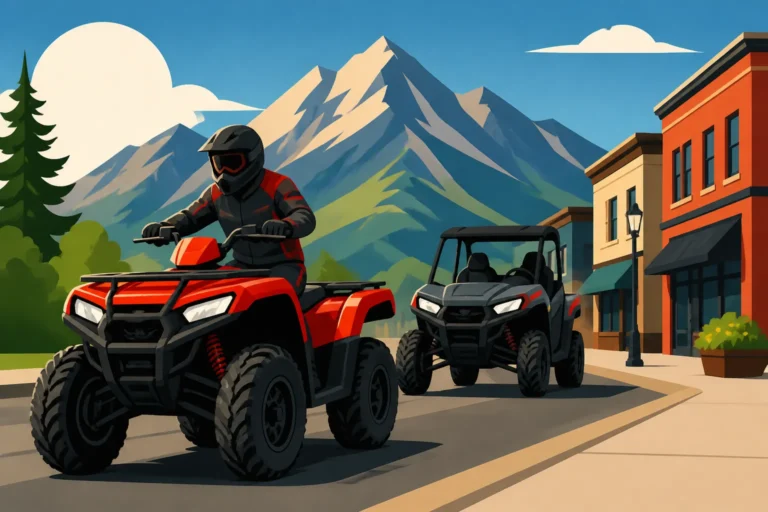
Picture this: you've been riding the trails all morning, the dust is thick, and your stomach is rumbling. You spot a small Montana town in the distance, promising a warm meal and cold drink. Many riders dream of pulling right up to a cafe or gas station on their OHV. In towns that have embraced OHV tourism, this is often possible and even encouraged. However, it's never as simple as just rolling in. You still need to stick to designated routes, often marked with clear signs, that lead you from the trail system to the main street where businesses are located. These routes are carefully chosen to minimize impact on residential areas and guide you efficiently to services.
Once you arrive at your destination, parking can become a new challenge. You can't just leave your side-by-side wherever you please. Look for designated OHV parking, or if none is available, park in a way that doesn't obstruct traffic, block entrances, or take up multiple car spaces. Common sense and courtesy go a long way here; avoid roaring through town at high speeds or making excessive noise, especially in areas with homes or businesses. Your goal is to be a good guest and a good ambassador for the OHV community. After all, the more positive interactions locals have with riders, the more likely they are to maintain or expand OHV access. [Parking an OHV on a Montana Main Street] provides more detail on this often-overlooked aspect of town riding. Remember to bring cash or a card, as not all small-town establishments are equipped for digital payments, and [Montana Gas Stations That Serve Riders] can guide you to fuel stops.
Connecting Trails via Town Roads
One of the most appealing aspects of OHV riding in Montana is the potential to link various trail systems, creating epic, multi-day adventures. Often, the missing piece of that puzzle is a short stretch of road through a town or across a county boundary. Many communities are recognizing this and actively working to create these connections, understanding that it enhances the overall riding experience and draws more visitors. These towns might collaborate with county commissioners to ensure a seamless flow from county roads onto their municipal streets, often leading directly to staging areas or onward to the next trail network.
However, resistance can also be strong. Some towns might explicitly prohibit OHV access through their core, forcing riders to trailer their machines around the community to reach the next section of trail. This can add significant logistical challenges and cut into valuable riding time. It's crucial to consult a detailed map that shows both designated OHV trails and any allowed road sections. Sometimes, a county might have opened a specific county road to OHVs, but if that road directly enters a town that hasn't approved OHV access, you'll still be out of luck once you hit city limits. This is where understanding the distinction between county rules and town ordinances becomes critical. Resources like local OHV clubs are often at the forefront of advocating for and mapping these connecting routes, making them an invaluable source of information. The topic of [County Commissioners and Montana County Roads] is highly relevant here, as their decisions often pave the way for such connections.
What to Do When Stopped by Law Enforcement
No one wants to see those flashing lights in their rearview mirror, especially when you’re trying to enjoy a ride. But it happens. If you are stopped by a sheriff's deputy or a town police officer while riding your OHV on a Montana street, the most important thing is to remain calm, be respectful, and cooperate fully. Immediately pull over safely to the side of the road, turn off your engine, and keep your hands visible. Fumbling for your paperwork or making sudden movements can escalate the situation unnecessarily.
The officer will typically ask for your driver's license, proof of OHV registration, and proof of insurance. Make sure you have these documents readily accessible, perhaps in a waterproof pouch you carry on your person or in a secure storage compartment on your machine. This is where all that pre-ride preparation pays off. If your machine isn't registered, or you don't have the proper safety equipment for road use, you could face fines, or in more severe cases, your machine could even be impounded. [Fines for an Unregistered OHV in Montana] can be significant, so it's always worth ensuring you're compliant. Answer questions honestly and politely, but you are not obligated to offer information beyond what is asked. Understanding your rights and responsibilities, and fulfilling them, makes the encounter smoother for everyone involved.
The Role of Advocacy and Community Engagement
For all the talk about rules and restrictions, it's important to remember that these ordinances aren't set in stone forever. They are a reflection of community priorities and concerns, and those can change. If you're passionate about expanding OHV access in Montana towns or improving existing conditions, becoming an active advocate and engaging with local communities is your most powerful tool. This isn't just about complaining; it's about being part of the solution and demonstrating the positive impact of responsible OHV recreation.
How Riders Can Influence Local Policy
Riders have a significant voice, especially when they organize and present a unified message. If you want to see changes or improvements in OHV access in a particular Montana town, your best bet is to attend town council meetings or county commissioner hearings. These are public forums where decisions are made, and your respectful, well-reasoned input can make a real difference. Instead of just stating what you want, focus on the benefits that increased OHV access could bring to the community. Highlight the economic advantages of increased tourism, explaining how riders will spend money at local gas stations, restaurants, hotels, and shops. Many small Montana towns rely heavily on tourist dollars, and OHV riders can be a significant part of that equation.
Furthermore, emphasize the commitment to responsible riding. Present ideas for designated routes that minimize conflict with residents, propose volunteer efforts to help maintain local infrastructure, or offer to help with signage. Showing that you've thought through the logistics and are willing to be part of the solution, rather than just demanding access, builds trust and goodwill. Remember, local officials are often balancing many competing interests, so a collaborative approach is far more effective than an adversarial one. By demonstrating the positive economic and recreational impact, and by advocating for thoughtful, safe integration, riders can genuinely influence local policy.
Joining Local OHV Clubs
Perhaps the single most effective way for riders to influence policy and stay informed about local ordinances is by joining a local OHV club. Montana boasts a number of active clubs composed of dedicated enthusiasts who are often the front lines of advocacy and trail stewardship. These clubs frequently work directly with local governments, the Forest Service, BLM, and other land managers to establish, maintain, and expand riding opportunities, including negotiating for town access. They are deeply entrenched in the local political landscape and understand the nuances of specific communities. [Montana OHV Clubs and Trail Adoption] is a great example of this collaborative spirit in action.
Local clubs are also invaluable sources of accurate, up-to-date information. They'll often have the inside scoop on which towns are opening their streets, which roads are designated routes, and where new trail connections are being planned. By becoming a member, you gain access to this collective knowledge and become part of a larger, more organized voice. Moreover, clubs actively promote responsible riding, which helps to build a positive image of the OHV community. They host events, organize clean-ups, and educate members on proper trail etiquette and safety. This responsible approach is crucial; when local officials see a well-organized, respectful riding community, they are far more likely to consider opening up access. Don't underestimate the power of collective action and positive community engagement.
Disclaimer
This article is for general informational purposes only and does not constitute professional advice. Laws, prices and regulations vary by location and change over time. Consult a qualified professional for guidance on your specific situation.