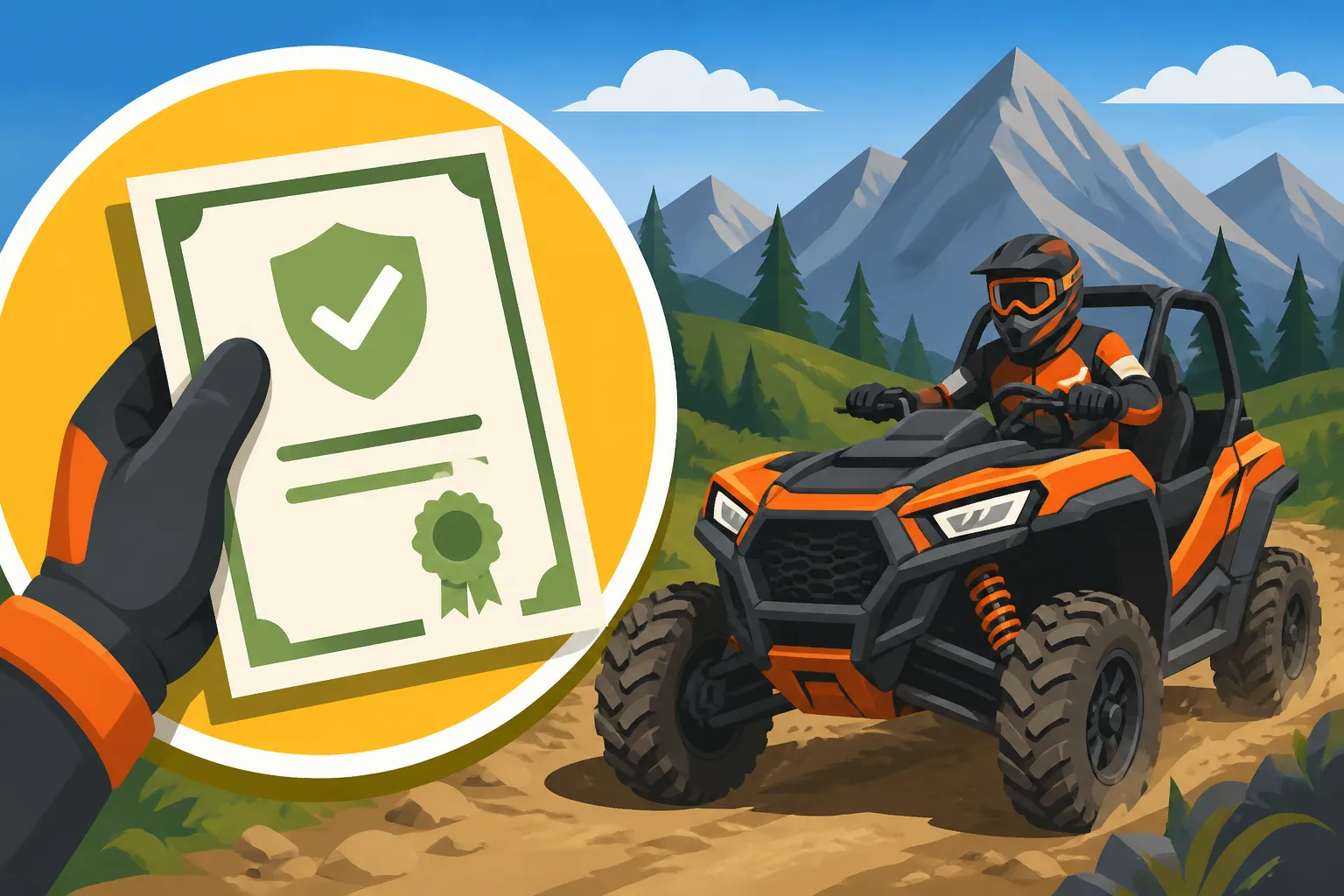
Carrying a Safety Certificate on a Road Ride
It's incredibly frustrating to think you've got all your ducks in a row for a great day of riding Montana's stunning backroads, only to realize you're missing a crucial piece of paper. Many riders, especially younger ones or those new to the state's regulations, often overlook or misunderstand the need to carry their OHV safety certificate while venturing onto public roads. This guide is here to untangle those rules, explain why that little piece of paper is so important, and help you avoid any unnecessary hiccups with law enforcement so you can enjoy your ride stress-free.
Understanding Montana's Safety Certificate Requirement
Navigating the rules and regulations for off-highway vehicles (OHVs) in Montana can feel like trying to find a specific trail on a sprawling forest map – there are many paths, and it's easy to get turned around. One area that often causes confusion, especially for families and new riders, is the requirement for a safety certificate, particularly when you plan to take your machine on public roads. It's not just about having the skills; it's about proving you've learned the rules.
Who Needs a Safety Certificate in Montana?
Montana, like many states, has specific provisions to ensure that young riders operating OHVs on public roads have a baseline of safety knowledge. This isn't about stifling their fun but about protecting them and others on shared routes. Generally, the core requirement for an OHV safety certificate in Montana applies to operators who are between the ages of 12 and 15 years old when they are riding on designated public roads or highways. If your child falls within this age bracket and plans to ride a quad or side-by-side on a county road, or even just cross one, they absolutely need to have completed an approved OHV safety education course.
Let's imagine a common scenario: The Jensen family from Idaho is visiting Montana for the summer, camping in the Custer Gallatin National Forest. Their 14-year-old, Liam, is an experienced rider on their ranch back home and wants to join his dad for a ride on some of the forest service roads that are open to OHVs. These roads are considered public thoroughfares. Even though Liam is a seasoned rider, if he hasn't completed a [Montana's Safety Education Requirement] course and obtained a certificate, he could be in violation of the law. This rule doesn't just apply to residents; it applies to anyone operating an OHV within the specified age range on Montana's public roads, regardless of where they call home. It's a fundamental part of [Montana Age Rules for Riders Under 16].
Now, if Liam was 16 or older and held a valid driver's license, the safety certificate requirement for road riding wouldn't apply to him. This distinction is crucial. The law recognizes that a licensed driver has already demonstrated a certain level of understanding of traffic laws and safe operation. However, for those younger riders, that safety certificate is their official stamp of approval, showing they've been taught the specifics of OHV operation, trail etiquette, and road safety.
The Difference Between Trail Passes and Safety Certificates
One of the biggest areas of confusion for riders in Montana is the distinction between a "trail pass" and an "OHV safety certificate." It's easy to conflate the two since both are pieces of paper related to legal OHV operation, but they serve entirely different purposes, and misunderstanding this can lead to an unexpected citation. You can have one without the other, and depending on your age and where you're riding, you might need both.
A trail pass, whether it's the [Montana's Resident OHV Trail Pass] or the [Montana's Non-Resident Temporary Use Permit], is essentially a user fee that contributes to the maintenance, development, and grooming of OHV trails and riding areas across the state. Think of it like a park entrance fee, but specifically for off-highway recreation. It's about access to the trails themselves. If you're going to ride on public lands, most often you'll need one of these passes affixed to your machine or carried with you, regardless of your age. This money helps keep the trails in good shape for everyone, from the single-track dirt bikers to the side-by-side crews.
On the other hand, an OHV safety certificate is all about operator competency and age-specific requirements. It certifies that an individual, typically within that 12-15 age bracket, has successfully completed a course designed to teach them how to safely and responsibly operate an OHV, especially when sharing space with other vehicles on public roads. It's proof of education, not proof of payment for trail access. For example, a 15-year-old might have their [Montana's Resident OHV Trail Pass] decal prominently displayed on their quad, meaning they've paid their dues for trail access. But if they're caught riding that quad on a county road without their safety certificate, they are still subject to penalties because they haven't met the age-specific educational requirement for that type of riding.
Consider the hypothetical situation of the Rodriguez family, who are heading to ride near the [Wild Bill OHV Trails in the Flathead Valley]. Their 13-year-old daughter, Sofia, is eager to ride her ATV. Her dad has already bought her a [Montana's Resident OHV Trail Pass], which is great for the trails. However, to get from their campground to the trailhead, they need to ride a short section of a gravel county road. Without Sofia having her OHV safety certificate in hand, that short jaunt on the road could land them in trouble. The trail pass gets her on the trails, but the safety certificate is what allows her to legally get to those trails if it involves public road use and she's in that specific age range. Understanding this clear distinction is key to a worry-free ride.
Why Carrying Your Certificate on the Road is Crucial
You've done the right thing, your younger rider has completed their safety course, and they've got their certificate. That's a huge step! But having it isn't enough; just like a driver's license, it needs to be with the operator when they're actually riding. Forgetting it, or assuming it's "in the system," can quickly turn an enjoyable outing into a stressful encounter with law enforcement.
Enforcement and Compliance Checks
Montana's backcountry roads, forest service routes, and even some small-town streets are patrolled by a variety of law enforcement agencies. You might encounter local sheriff's deputies, Montana Highway Patrol officers, or even Montana Fish, Wildlife & Parks (FWP) wardens. These officers are well-versed in OHV laws and often conduct compliance checks, especially in areas popular with riders. When an officer pulls over an OHV on a public road, they're not just looking for speeding or reckless operation; they're checking for proper registration, decaling, and, crucially, operator qualifications.
Imagine you're riding with your 14-year-old nephew, Ben, on a scenic county road that connects two sections of trail near Missoula. Ben is operating his own machine, and a county sheriff's deputy spots him. The deputy might initiate a stop simply to check compliance, especially given Ben's apparent age. The deputy will likely ask for proof of machine registration, a driver's license (if applicable to an older rider), and, in Ben's case, his OHV safety certificate. This is a routine part of ensuring safety and adherence to the law. An officer might also want to confirm that the machine meets other [Montana Road Rules for Young Riders], such as having proper lighting or a spark arrestor.
What happens if Ben has the certificate, but it's back in the truck, or worse, at home? The officer's job is to ensure immediate compliance. While some officers might exercise discretion, the burden of proof is on the rider. It's very similar to being asked for your driver's license when you're pulled over in a car; saying it's at home usually won't prevent a citation. This is precisely why [What a Montana Warden Asks a Rider For] includes all relevant documentation. They're trying to quickly ascertain if the operator meets all the legal requirements for riding on that specific public thoroughfare.
Consequences of Not Having It
The immediate consequence of not having a required safety certificate with you, even if you've earned it, is almost certainly a citation. These aren't just polite warnings; they come with fines. The exact amount can vary depending on the jurisdiction and the specific circumstances, but it's money out of your pocket that could have been avoided with a simple piece of paper. These [Montana Fines for Illegal Road Riding] are designed to deter non-compliance and reinforce safety standards.
Consider the example of Sarah, a 15-year-old from Kalispell. She diligently took her OHV safety course online and passed with flying colors. Her certificate is proudly displayed on her bedroom wall. One sunny Saturday, she and her friends decide to ride their side-by-sides on some gravel roads out past Ashley Lake. A state trooper pulls them over as part of a routine check. When asked for her safety certificate, Sarah can only sheepishly explain that it's at home. Despite having completed the course, she's still issued a ticket for failing to carry proof of her certification while operating on a public roadway. This can be a real blow to a young rider's confidence and, more practically, to the family's wallet.
Beyond the monetary fine, there can be other headaches. Depending on the severity or if there are other violations, it could even lead to a temporary suspension of riding privileges for the young operator, or impounding of the machine in extreme cases, though this is less common for a first-time paperwork offense. The whole experience can be stressful and embarrassing, completely overshadowing the fun of the ride itself. It’s an easily avoidable frustration. By simply ensuring that the safety certificate is physically present with the rider, you eliminate this entire category of risk and allow the focus to remain on enjoying Montana's incredible landscapes.
Practical Tips for Carrying and Protecting Your Certificate
You've understood the "why" behind carrying your safety certificate. Now, let's talk about the "how." Montana's weather can be unpredictable, trails can be dusty or muddy, and machines can bounce and vibrate. Keeping important documents safe and accessible requires a little forethought to ensure they survive the adventure as well as you do.
Best Practices for Document Storage
Storing your safety certificate, along with other essential documents like proof of [Montana County Treasurer OHV Registration] or your driver's license (if applicable), means protecting them from the elements and ensuring they don't get lost. Simply stuffing them into a pocket might work until a surprise rain shower hits or you take a tumble. The key is to keep them dry, secure, and easily retrievable.
A fantastic solution is a waterproof document pouch or a durable, waterproof storage bag. Many OHV accessory companies, including brands like SuperATV, offer specialized storage solutions that are designed to withstand the rigors of off-road riding. These might be soft-sided bags that strap onto racks, or hard-sided storage boxes that mount securely to your machine, such as a UTV's cargo bed or a quad's front rack. They protect against rain, dust, mud, and vibrations. Look for options that are easy to open with gloved hands but seal tightly to keep moisture out. You might even consider having a small, dedicated waterproof wallet or case that you can slip into a jacket pocket or a secure compartment on your machine.
Another wise move is to laminate a copy of the certificate. While the original should be kept in a safe place, a laminated copy is much more durable for daily trail use. If it gets wet or muddy, it can simply be wiped clean. Always make sure the laminated copy is clear and readable. Some riders even make a clear photocopy and then laminate that, keeping the original pristine at home. For any important paperwork, including your [Keeping Registration Papers on the Machine], having it secured means one less thing to worry about when you're miles into the [Bitterroot National Forest OHV Trails].
Digital Copies Versus Physical
In our increasingly digital world, it's natural to wonder if a picture of your safety certificate on your phone will suffice. While having a digital backup is always a good idea – it's better than nothing if your physical copy is lost or destroyed – relying solely on a digital image can be risky in Montana's vast backcountry.
First and foremost, cell service in many of Montana's prime riding areas is notoriously spotty to non-existent. You could be deep in the [Beartooth Country] near Red Lodge, on a stunning trail ride, and have absolutely no signal to pull up an email or cloud-stored document. Law enforcement officers operating in these remote areas are well aware of this and might not accept "I'll show it to you when I get signal" as an excuse. They often need to verify documents on the spot.
Secondly, while some jurisdictions might accept a clear digital image, it's not universally guaranteed. The most ironclad proof is always a physical, official document. Officers are often looking for specific holograms, seals, or paper types that digital images can't replicate. It's best to treat the physical certificate as the primary, required document, and the digital copy as a convenient secondary backup. So, while having a picture on your phone won't hurt, it shouldn't be your only plan. A printed, laminated copy is always a safer bet.
Other Documents to Keep Handy
While the safety certificate is the star of this particular show, it's just one player in the ensemble of documents you should have with you when riding an OHV on Montana's roads. To ensure you're fully compliant and prepared for any situation, here's a quick checklist of other important papers:
- OHV Registration Proof: This is non-negotiable for operating on public land or roads. You'll need proof that your machine is properly registered with the state of Montana.
- Driver's License: If you are 16 or older and operating an OHV on a public road, you absolutely need a valid driver's license. This is a fundamental part of [Driver's License Rules for Montana Road Riding].
- Proof of Insurance: Montana law requires liability insurance if you're operating your OHV on a public road or highway. Have your insurance card or declaration page readily available.
- Owner's Manual/Basic Info: While not legally required to carry, having a small, waterproof copy of your owner's manual or a cheat sheet with basic machine specs (like VIN location, tire pressure, and fluid types) can be incredibly helpful for roadside issues or questions.
- Permits for Specific Areas: Some specific trails or areas might require additional local permits. Always check the regulations for your planned riding spot.
Imagine a typical scenario: You're riding your side-by-side with your family on a gravel road in the [Helena-Lewis and Clark Forest Riding] area. An FWP warden pulls you over for a routine check. They'll likely ask for your driver's license, proof of registration for your UTV, your insurance card, and if your 14-year-old is operating their own machine, their OHV safety certificate. Having all these documents organized in a single, waterproof pouch means a quick, smooth interaction and a return to your ride without delay. Being prepared means less stress and more enjoyment of Montana's beautiful scenery.
| Document Type | Who Needs It (Generally) | Where to Carry It | Primary Purpose |
|---|---|---|---|
| OHV Safety Certificate | Riders 12-15 on public roads/trails | On person or in machine's storage | Proof of safety education for young operators |
| Driver's License | Operators 16+ on public roads | On person | Proof of legal driving privilege |
| OHV Registration Proof | All machines on public land/roads | In machine's storage | Proof of state registration |
| Proof of Insurance | All machines on public roads/highways | In machine's storage | Proof of liability coverage |
| Trail Pass (Decal/Card) | All machines on designated trails | Affixed to machine or in storage | Funding for trail maintenance & access |
The open roads and vast trails of Montana offer some of the most spectacular OHV riding experiences imaginable. But to truly enjoy them without interruption, especially when you're dealing with public roads, a little preparation goes a long way. Ensuring that your young riders (or anyone in the age-restricted bracket) have their OHV safety certificate with them is a small but critical step. It prevents unnecessary fines, avoids stressful encounters with law enforcement, and most importantly, reinforces the importance of safe and responsible riding for everyone. So, before you hit that ignition and head out for an epic Montana adventure, double-check that certificate – it's your ticket to a worry-free ride!
Disclaimer
This article is for general informational purposes only and does not constitute professional advice. Laws, prices and regulations vary by location and change over time. Consult a qualified professional for guidance on your specific situation.