How Montana Search and Rescue Reaches You
A crash, breakdown, or medical emergency on a Montana trail can leave you far from a road and outside cell coverage. Search and rescue may be able to help, but responders need a way to learn that you need help and work out where to look. Knowing how an alert gets routed—and what information to share—can make it easier for them to find you.
How a Search and Rescue Call Gets Started
In an emergency, call 911 if you have a working phone connection. Tell the call taker that you need help in the backcountry, explain what happened, and give your location as clearly as you can. Depending on where you are and what kind of help is needed, local dispatch may involve a sheriff’s office, a search and rescue team, fire or medical responders, or other agencies. The exact response varies by location and circumstances.
Search and rescue teams in Montana are often organized locally, and many rely on volunteers. They may be asked to locate a missing or injured rider, reach someone who cannot safely get out, or help coordinate a response across difficult terrain. A rescue is not necessarily a single team arriving at once: dispatchers and responding agencies may share information and make a plan as they learn more.
A call to 911 is not a guarantee that rescuers will immediately know your exact position. A phone may provide location information, but its accuracy and availability can vary. In remote terrain, a call may fail, disconnect, or provide only a broad area. Give the dispatcher clues that can narrow the search, such as the trail or road name, a route number, a trailhead, a nearby junction, a landmark, or the direction you were traveling.
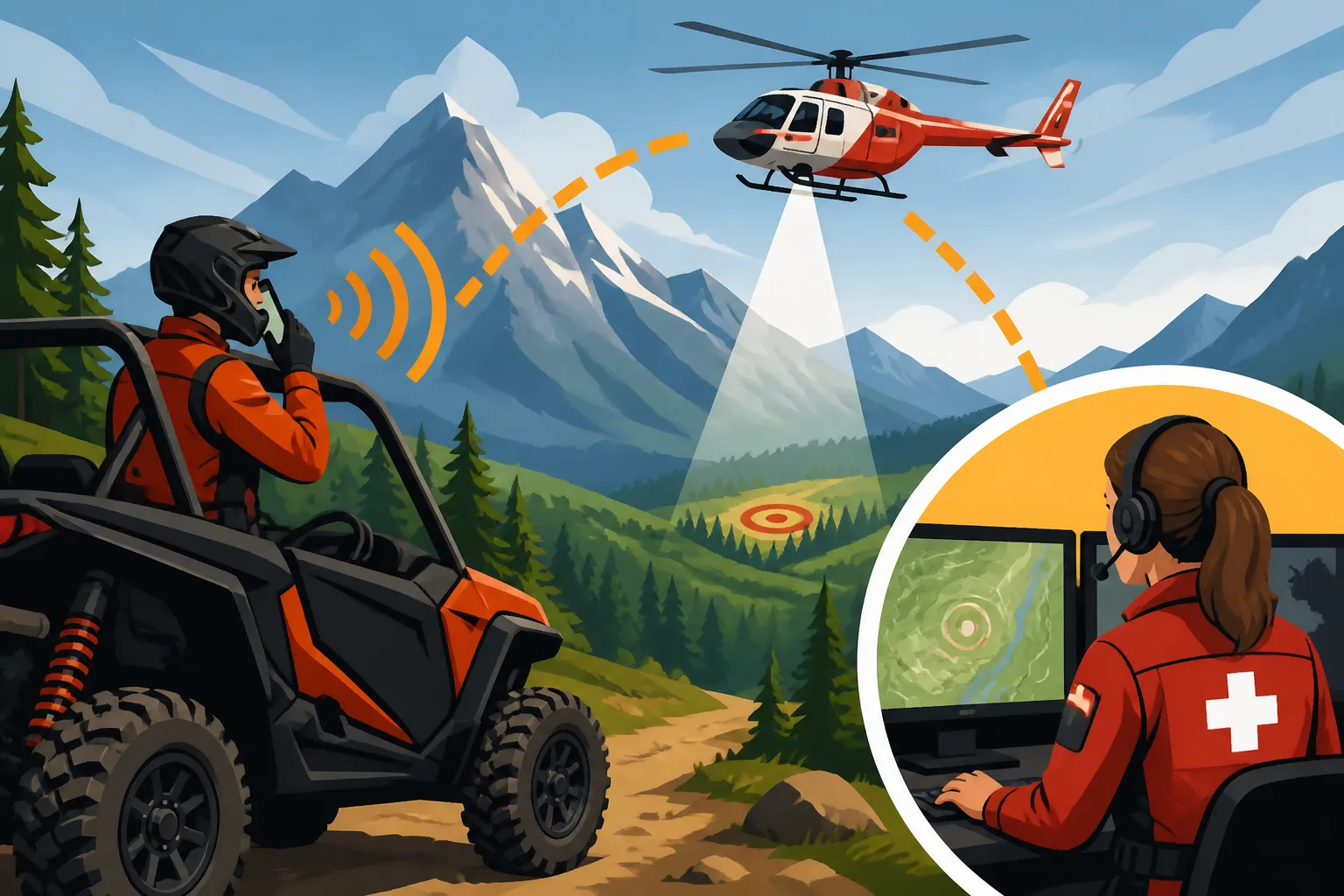
If you cannot make a voice call but have a satellite messenger or another device with an SOS function, use its emergency feature according to its instructions. A satellite SOS typically goes first to the device provider’s emergency coordination service, which can relay the alert and details to appropriate local responders. The steps and communication options differ by device and service, so read the instructions before your ride and know how to confirm that an alert was sent.
| How help is requested | What may happen next | What you should do |
|---|---|---|
| Phone call to 911 | Dispatch asks questions and coordinates an appropriate local response | Stay on the line if possible and describe your location, injuries, and hazards |
| Satellite SOS | The device’s emergency service receives the alert and relays information to responders | Keep the device powered, follow its prompts, and send updates if it allows them |
| Message from someone outside the riding group | Dispatch may receive a report that riders are overdue or missing | Give the person your itinerary, expected return time, and machine and rider details in advance |
| Alert from another rider or witness | Responders may be sent to the reported location or begin checking the route | Share accurate details and do not leave an injured person alone unless there is an immediate danger |
Use the best working option available. If you have phone service, a call can allow dispatch to ask follow-up questions. If you do not, an SOS device may provide a way to ask for help where a phone cannot connect. Neither replaces good trip planning. A description of your route and a reliable check-in plan can give responders useful context if you cannot raise an alarm yourself.
For related preparation, see Cell Service in the Montana Backcountry and Carrying a Satellite Messenger in Montana. If you ride alone, Riding Alone in the Montana Backcountry covers additional ways to reduce the difficulty of a delayed or emergency response.
How Responders Work Out Where You Are
Location is often the hardest part of a backcountry rescue. Montana’s riding areas can include long stretches without cell coverage, confusing junctions, changing trail conditions, and terrain that makes travel slow. A place name that seems obvious to your group may not tell dispatch exactly which trail you took or which side of a ridge you are on.
When you speak with 911, answer questions as directly as you can. Try to identify:
- The trailhead, road, recreation area, or access point where you started.
- The name or number of the route, if you know it.
- The last junction, crossing, bridge, or landmark you passed.
- The direction you were traveling and the time you were last moving.
- Your best estimate of your location, including coordinates if you have them.
- The number of people in your group, the number of machines, and whether anyone is missing.
- The nature of the injury or problem and whether the person is conscious and breathing.
- Any immediate hazards, such as fire, rising water, unstable ground, or a machine blocking the route.
If your phone or navigation device shows coordinates, read them slowly and clearly. Confirm which coordinate format you are using if you know it. A small mistake in a coordinate can send responders to the wrong place, so repeat the numbers or send them in a message when possible. Do not assume the location shown on a map pin is precise enough on its own; describe nearby features as well.
A breadcrumb track or saved route can be especially useful when your group has traveled through several turns. If you have a map app or GPS, tell dispatch what app or device you are using and whether you can send a location or route file. Do not spend so long trying to share a map that you delay making the emergency call. Give the clearest verbal location you can first, then provide extra information if asked.
Responders may use the reported location, route information, and available resources to decide how to reach you. The best approach can depend on access, terrain, weather, daylight, the person’s condition, and the equipment available. An aircraft may be considered in some situations, but it is not guaranteed; weather, visibility, landing conditions, and operational limits can affect whether it can help. A ground team may need time to reach a remote location, especially if a route is rough, closed, or unsuitable for a full-size response vehicle.
Once you have made contact, stay where you are unless staying puts someone in immediate danger or dispatch tells you to move. Moving can make your reported location outdated and complicate the search. If you must relocate, tell dispatch or send an updated message as soon as you can. Keep the injured person as safe and comfortable as possible, and avoid taking risks that could create additional injuries.
A rescue may involve more than finding the group. If someone is hurt, responders need to assess how to reach and evacuate them safely. That can take time and may require coordination among teams. Keep your phone or satellite device available for further questions, and conserve its battery if you expect to wait. Follow instructions from dispatch and responders rather than trying to arrange a risky self-rescue.
What Helps Search and Rescue Find You Faster
The most useful preparation happens before anyone needs to call for help. Give a person who is not on the ride your plan, including where you intend to ride, your expected return time, and when they should act if you have not checked in. Make the plan specific enough that the person can report a useful route rather than simply saying you went riding somewhere near a particular town.
Your plan should include:
- The riding area and intended route, including alternate routes if you may change plans.
- The trailhead or access point where you expect to start and finish.
- The names or descriptions of riders and the number of machines.
- The machine make, model, color, and other details that distinguish it.
- Your expected return and check-in times.
- How the contact person should reach you and what to do if you miss the check-in.
Agree on what “overdue” means before leaving. A person who does not know whether you planned a short loop or an all-day ride may not know when a missed check-in is cause for concern. If the plan changes, tell your contact before you lose service. Do not rely on someone guessing which trail you chose.
A satellite messenger can offer an additional way to send an SOS or check-in from areas without phone coverage. Before relying on one, learn how its emergency function works, keep it charged, and carry it where it can communicate with the sky rather than buried under gear. Check the device’s instructions for how it sends alerts and whether you can send messages or location updates. A device is only useful if it is with you, ready to operate, and understood by the person using it.
Carry a map or navigation option that works for your route, and know how to read your location from it. Download maps or save routes before leaving service, where the tool allows it. Bring a power bank or another practical way to keep devices charged. These steps can help with ordinary navigation as well as an emergency. What to Carry on a Remote Montana Ride offers more planning ideas.
When making an emergency call or sending an SOS, use plain language. Say “I need medical help” or “a rider is injured and cannot move” rather than relying on a vague description such as “we have a problem.” If you are unsure whether an injury is serious, describe what you can observe and let dispatch guide the next steps. Do not exaggerate, but do not minimize the situation either.
Keep the group together when it is safe to do so. Sending one rider away to find help can leave an injured person without support and may create another person for responders to locate. If someone must go for assistance because no communication device works, make a clear plan: who is staying, who is leaving, which route they will take, and what information they will provide. Consider the group’s actual skill, the terrain, weather, and the injured person’s needs before moving anyone.
After a crash, prioritize immediate safety and contact emergency services when needed. If machines or riders are in a hazardous position, warn other trail users where you can do so safely. Record the location and relevant details while they are fresh, but do not delay urgent care to gather paperwork or take photos. For the next steps after an incident, see After a Crash on a Montana Back Road and Montana OHV Crash Reporting.
Before the trip, check for route closures and changes that could affect access. A planned route may not be passable or open when you arrive, and an alternate route can change your estimated return time. Checking Montana Trail Status Before You Drive can help with pre-ride planning. Accurate plans, clear location details, and a working way to call or send an alert do not guarantee a quick rescue, but they give dispatch and responders a better starting point.
Disclaimer
This article is for general informational purposes only and does not constitute professional advice. Laws, prices and regulations vary by location and change over time. Consult a qualified professional for guidance on your specific situation.