Supervising a Young Rider on a Ranch
A ranch can feel like the safest place for a child to learn to ride an ATV or UTV, but wide-open ground still has hazards: farm equipment, livestock, steep banks and roads with public access. Supervising a young rider in Montana means checking which rules apply, choosing a machine the child can control, and staying close enough to intervene.
First, establish where the ride will take place
“On the ranch” is not always the same as “on private land.” A ranch may include deeded ground, leased parcels, access easements, county roads or a route that connects to public land. The rules can change as a rider moves from one type of property to another, so identify the boundaries before starting the engine.
Ask the landowner or ranch manager which areas are open to the child and which are off limits. Permission to ride one field or two-track does not necessarily include permission to use a neighboring parcel, an access road or a public trail. Keep the planned route on ground where the owner has authorized riding.
Private land also does not automatically settle every question about registration, equipment or a rider’s age. Rules may depend on the machine, the rider, the road or trail being used, and whether the land is genuinely private or open to public travel. Check the current requirements with the appropriate Montana agency before riding outside the ranch’s private area. Montana Rules on Private Land and Do You Need a Permit on Deeded Montana Ground? cover related distinctions.
| Where the child rides | What to check before setting out |
|---|---|
| A private field or ranch trail | Landowner permission, hazards, boundaries and whether any state requirements still apply |
| A ranch road | Whether it is private, public, or an easement; road-use rules may differ from off-road rules |
| A public trail or public land | Current access, permit and safety requirements, plus any age-related restrictions |
| A route that leaves the ranch | Permission and requirements for every section of the route, not just the starting point |
If the ride reaches public land, do not rely on private-property permission as a substitute for the applicable permit or safety requirements. Montana’s permit rules and safety education requirements can depend on where and how a machine is used. Review Montana Permit Rules on Public Land and Montana OHV Safety Education Requirements, and confirm details with the relevant official source.
A rider’s age may matter too. Do not assume the rules for a private field, a public trail and a road section are identical. Montana Age Rules for Riders Under 16 and Montana Rules for Riders Under 12 are useful starting points for checking age-related questions. If the proposed route includes a road, check road-specific rules separately; permission to travel on a ranch does not by itself authorize riding on a public road.
Match the machine to the child, not the other way around
A young rider needs a machine that fits their present abilities. A child who can reach the controls while parked may still struggle to operate them under pressure, especially on uneven ground or while wearing gloves. Before the ride, have the child sit on the machine with the engine off and demonstrate how they will steer, brake, shift if needed, and use the throttle.
Check that the child can:
- Reach and operate the controls without stretching or changing their grip.
- Turn the handlebars through the full range without losing a secure position.
- Use the brakes firmly and understand how the machine responds.
- Keep a stable riding posture and get on and off safely.
- Stop the machine on command and explain what they should do if it stalls.
A machine that is too powerful or physically large can be difficult to manage even for a confident child. Consider the machine’s size, weight, speed, throttle response and braking characteristics—not only its engine size or the child’s age. Manufacturer guidance is a sensible starting point, but it cannot replace an adult’s assessment of the child’s coordination and judgment. Youth Machine Size Rules Montana Parents Ask About discusses the sizing question in more detail.
For a UTV, check that the child is using a designated passenger seat and can sit properly with the restraint fastened. Never let a child ride as a passenger in a position that is not designed for one. A seat belt and protective structure do not make an unsuitable passenger arrangement safe. For an ATV, do not add a passenger to a machine designed for a single rider.
Set a conservative limit on speed and terrain. A beginner does not need to prove they can manage a steep hill, a ditch, a water crossing or a fast straightaway. Start on a flat, open area with good visibility and enough room to stop. Add difficulty only when the rider consistently follows instructions and controls the machine smoothly.
A safety course can teach skills and safety habits that are hard to cover in a quick family briefing. Check whether a course or certificate is required for the rider’s age and intended riding area, and consider it even where it is not required. See Who Must Take the Montana Course and What Montana’s OHV Safety Course Teaches.
Supervise actively, not from a distance
Effective supervision means being close enough to see what the child is doing, hear the machine and respond quickly. Watching from the house, following far behind in another vehicle or assuming an older child will keep a younger one safe is not a substitute for direct oversight.
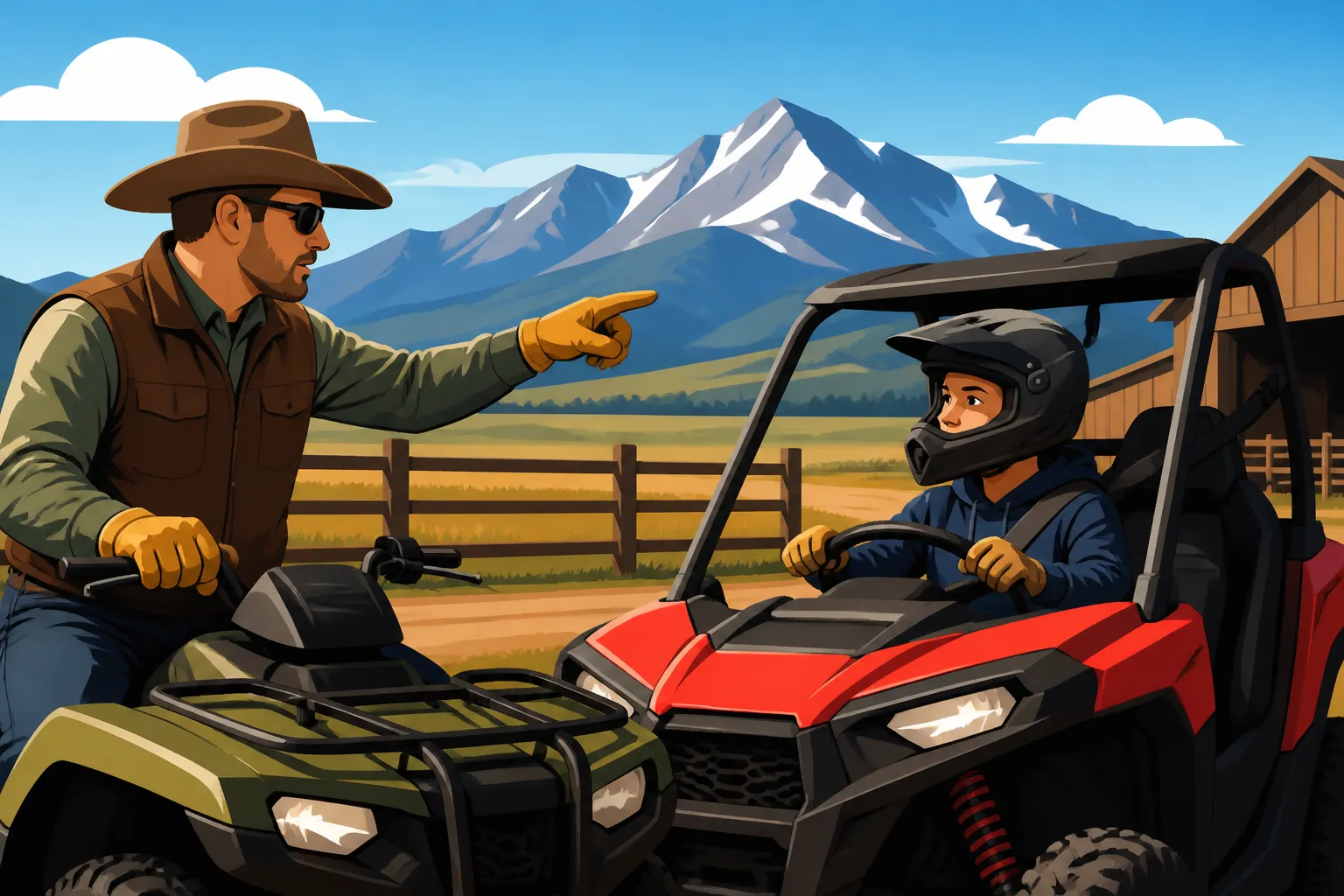
For a new rider, position yourself where you can see the whole practice area and the route ahead. Keep other children and bystanders away from the riding zone. If the child is on an ATV, have them practice starting, stopping and turning in a controlled area before moving onto a trail. If they are in a UTV, explain how to use the belt, doors or nets, and the controls before driving.
Use short, clear instructions. Agree on a stop signal that works over engine noise, and make sure the child understands that a signal means stop as soon as it is safe to do so. Set a small, visible boundary for the first session. A child should not ride out of sight or beyond the agreed route. If terrain or vegetation blocks your view, move closer or choose a different practice area.
Supervision should become more cautious when the ground, the rider or the situation changes. Stop and reassess if the child is tired, upset, distracted or struggling to follow directions. Dust, glare, changing weather and other machines can make it harder to see and communicate. A short ride with a focused child is safer than extending a session after attention has faded.
Before a child rides, explain the specific ranch hazards. Common examples include:
- Livestock, calves, horses and working dogs that may move unpredictably.
- Tractors, trucks, irrigation equipment and other machinery.
- Open gates, fences, wire, cattle guards and narrow passages.
- Ditches, culverts, steep banks, loose gravel and soft ground.
- Ponds, streams and irrigation channels, including slippery or undercut edges.
- Blind corners, buildings, fuel storage and areas where adults may be working.
Agree on no-go areas and mark them in a way the child can recognize. Do not expect a child to judge whether a gate, fence line or road is safe to cross on their own. If ranch work is underway, keep the young rider out of the work area unless the adults coordinating the job have planned a safe separation.
Helmet and protective-gear rules can depend on the rider and where the machine is used. Check the requirements that apply to the child rather than assuming private property removes them. A properly fitted helmet, eye protection, gloves, long sleeves, long pants and sturdy footwear are sensible precautions for riding on a ranch. Review Montana Helmet Requirements Under 18 for the rules that may apply, and make sure the helmet fits securely and is intended for the activity.
Make a ranch riding plan before the engine starts
A quick plan prevents avoidable arguments and gives the child clear limits. Decide who is supervising, which machine the child will use, where they may ride and what will end the session. If more than one adult is present, agree on who is responsible for watching the rider; shared attention can become no attention if everyone assumes someone else is in charge.
Use this checklist before each ride:
- Confirm permission and boundaries. Identify the exact area the child may use and any roads, gates, buildings, livestock areas or public routes to avoid.
- Check the machine. Inspect the tires, brakes, throttle, steering, lights and any restraint system. Do not let the child ride a machine with a problem that could affect control.
- Fit protective equipment. Check the helmet and eye protection, and make sure clothing and footwear are suitable for the conditions.
- Review the plan. Name the route, the stop signal, the speed expectation and what the child should do if they lose sight of the supervising adult.
- Start on easy ground. Watch the child demonstrate basic control before allowing a longer route or more difficult terrain.
- Stay within sight and hearing. Keep close enough to stop the ride if the child approaches a hazard or ignores an instruction.
- End the session early if needed. Fatigue, frustration, poor visibility or changing ranch work are reasons to stop, not challenges a child needs to push through.
Keep the first route short and predictable. A loop near the supervising adult is easier to manage than a long route through several fields. If the machine is being used for ranch work, separate the child’s learning ride from tasks that involve moving livestock, hauling a load or working near other vehicles. Work use adds distractions and may bring different legal considerations. Riding a Family Ranch Without Registration and Farm and Ranch Exemptions in Montana address related questions, but confirm how the current rules apply to the specific machine and activity.
After the ride, ask the child what felt difficult and whether anything unexpected happened. Check the machine for damage and make a note of any route hazards to avoid next time. A child who can describe a problem calmly may be ready to practice a little more; a child who cannot follow the stop signal or remember the boundaries needs a simpler setup and closer supervision.
The practical standard is straightforward: the young rider should be able to control the machine, understand the limits, and stay within an area where an adult can supervise effectively. If any of those conditions is missing, change the machine, the route or the plan before riding again.
Disclaimer
This article is for general informational purposes only and does not constitute professional advice. Laws, prices and regulations vary by location and change over time. Consult a qualified professional for guidance on your specific situation.