Where Montana Trail Pass Money Is Spent
A Montana OHV trail pass is more than a requirement to ride on public land: its revenue helps support motorized recreation. But not every dollar goes directly to trail work, and resident-pass grants are a distinct program from another state OHV grant program. Here’s how the funding is divided, what projects can receive support, and what riders can reasonably expect that money to do.
How Montana OHV trail pass revenue is divided
A pass payment supports a group of OHV-related purposes rather than paying for a particular trail or ride. According to Montana State Parks, 65 percent of revenue from OHV trail passes and permits is distributed through grants to maintain OHV trails. The remaining 35 percent is divided among OHV enforcement, noxious weed control, Search and Rescue, and compensation for permit sellers.
| Share of pass and permit revenue | Main destination | What that means for riders |
|---|---|---|
| 65 percent | Grants to maintain OHV trails | Grant-funded work can support upkeep and improvements on motorized routes. |
| 35 percent | OHV enforcement, noxious weed control, Search and Rescue, and permit seller compensation | The pass supports services and administration as well as trail work. |
The split is useful context when judging what a pass funds. The grant share is substantial, but trail maintenance is not the only purpose of the revenue. Enforcement and weed control, for example, help address issues connected with motorized use; Search and Rescue is another funded purpose. Permit sellers also receive compensation from the non-grant share.
This does not mean that every dollar can be traced to a particular trail segment or that every trail receives work in a given season. The grant process directs funding to projects, and the location and type of work depend on the projects selected. If you want a broader explanation of how grants relate to trail work, see Where Montana Trail Pass Money Goes—no, that’s the article’s own title, so do not link it. See Montana State Parks OHV Grants and Montana Trail Grants to Local Clubs for related topics.
It also helps to distinguish trail pass funding from registration. A trail pass and a permanent registration are not interchangeable paperwork, even when an owner handles them together. For an overview of the resident pass itself, see Montana’s $20 Resident OHV Trail Pass Explained. For the registration side, Trail Pass Credit Toward Permanent Registration covers the connection between a pass purchase and permanent registration.
A pass is also not permission to ride anywhere. Riders still need to follow the applicable land manager’s route and access rules. The pass-related funding supports the recreation system; it does not make a closed route open or replace other required permissions. Review Montana Permit Rules on Public Land and What Montana Riders Need Before They Ride before heading out.
How resident pass revenue supports trail projects
Montana Fish, Wildlife & Parks describes a specific funding pathway for resident pass revenue: the Summer Motorized Trail Pass Program, commonly called the SMTP Program. Montana Fish, Wildlife & Parks says the program provides grant funding to OHV clubs and organizations, with funding coming from sales of the OHV Resident Trail Pass. Montana State Parks administers the program, and the Off Highway Vehicle Advisory Committee assists in grant allocation.
That division of responsibilities matters. Resident pass revenue supports a grant program, while an advisory committee helps with allocation and the state agency administers the program. This is different from saying that a particular club automatically receives money because it maintains a popular route. A project has to fit the grant program and go through its application process.
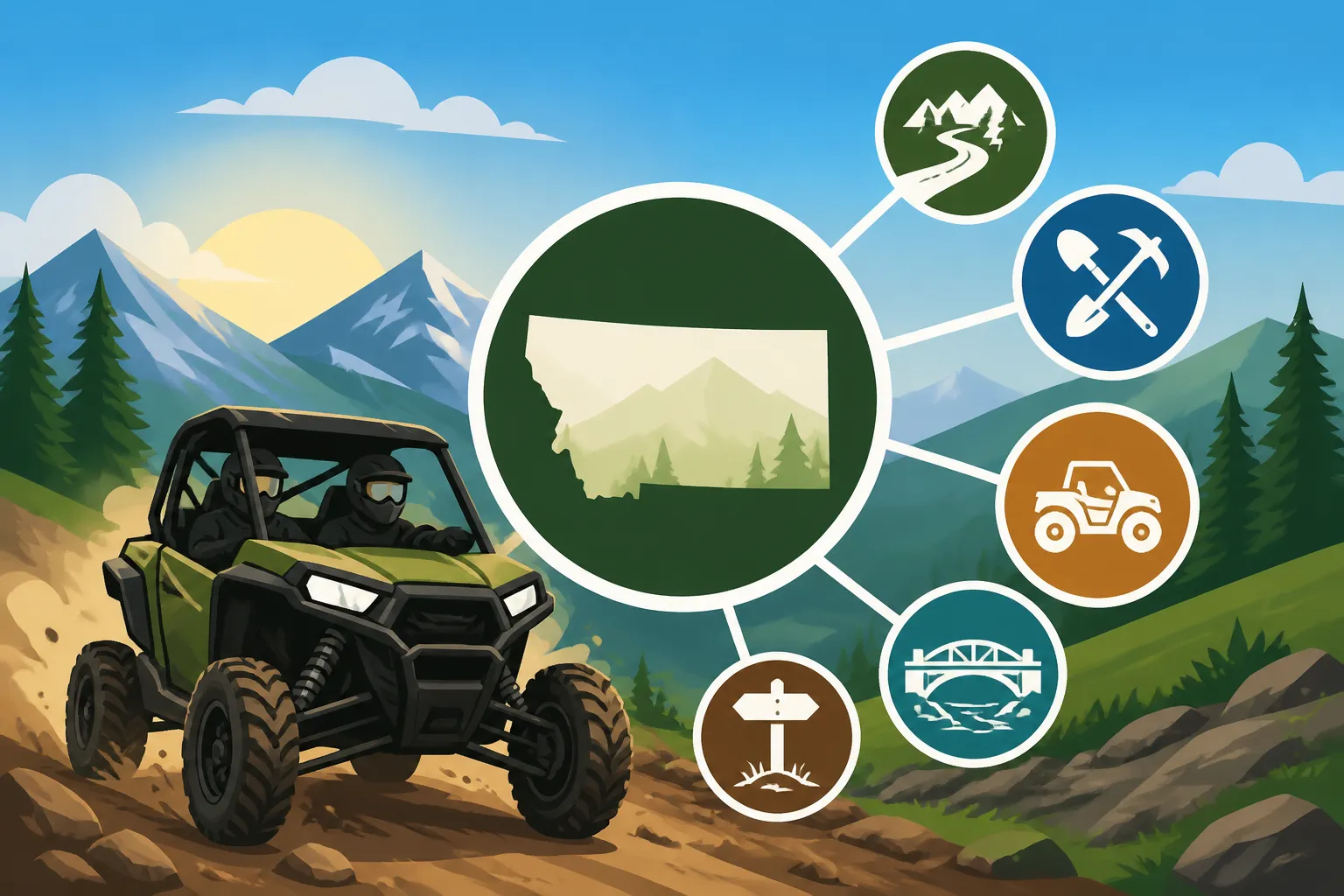
The SMTP grant program can support work such as:
- Installing or improving signs and trail markers.
- Maintaining trails, improving trail conditions, or rerouting a trail.
- Addressing impacts caused by motorized use.
- Brushing and delimbing trails to improve passage.
- Controlling noxious weeds along trail corridors.
- Paying for a club-hired trail steward to clear and maintain trails.
These examples show why “trail funding” can mean more than grading or repairing a worn section. Markers help identify routes; reroutes may address a problem along an existing route; weed control and resource-impact mitigation address effects around the trail corridor. A club-hired steward can provide ongoing clearing and upkeep. Which type of work a grant supports depends on the project proposal and award decision, not on a rider selecting a destination.
The application calendar offers a practical way to understand when proposed projects move through the process. According to Montana Fish, Wildlife & Parks, the SMTP grant application cycle opens on November 15 each year, closes on February 1, and funding decisions are announced in late April. Applications are accepted through WebGrants. Those dates describe the program cycle; they do not guarantee that every application will be funded.
For clubs and organizations doing trail work, an application needs to connect the requested work to the program’s eligible purposes. A proposal focused on signs, maintenance, improvements, rerouting, resource-impact mitigation, brushing, delimbing, weed control, or a hired trail steward fits the categories identified by Montana Fish, Wildlife & Parks. The exact application requirements and current process should be confirmed through the official program before preparing a request.
For riders, the important point is that the pass contributes to a managed funding program, not an informal reimbursement system. A club’s volunteer work may be visible on the trail, but the presence of volunteers alone does not show whether a project received a grant. Likewise, a route that needs attention may not be funded immediately. The program relies on proposals, eligibility, review, and funding decisions.
What funded work can change on the trail
Grant-supported projects can address practical problems that riders notice: unclear junctions, brush narrowing a route, maintenance needs, or a section that requires a reroute. The eligible project list gives a useful way to think about what a funded project might accomplish without promising a specific result at a specific location.
Signage and trail markers can help riders identify the route they are allowed to use and recognize important turns. Maintenance and trail improvements may address wear or other conditions affecting the route. Brushing and delimbing can clear encroaching vegetation, while a reroute can move a trail away from an area where the existing alignment is unsuitable. Noxious weed control and mitigation of motorized resource impacts address corridor and land impacts, not simply the riding surface.
A grant can also support a club-hired trail steward to clear and maintain trails. That category is especially relevant to ongoing work: a trail may need attention at more than one point in the season, rather than a single improvement that solves every maintenance issue. The eligible project description allows for this kind of staffing support, but it does not establish how often a steward will work on any particular route.
The presence of a pass-funded program should not be read as a promise that all OHV trails are maintained to the same standard or that a given route will be open whenever a rider arrives. Trail conditions, access, and closures are separate practical questions. Before traveling, check the route information for the area and avoid assuming that a pass confirms access. For planning help, Checking Montana Trail Status Before You Drive and Finding a Forest’s Motor Vehicle Use Map are useful related topics.
When you see a problem, be specific in reporting it. A clear description of the route, the junction or segment, and the issue is more useful than a general statement that a trail is in poor shape. If the problem is missing or confusing markers, say that; if brush is blocking passage or a section appears damaged, describe that instead. Riders can also look for local club involvement through Montana OHV Clubs and Trail Adoption and learn more about reporting trail issues in Reporting Trail Damage in Montana.
These steps do not guarantee that a report will become a funded project. They do help distinguish immediate trail observations from the longer grant cycle. A rider’s report can identify a concern, while an eligible grant proposal and subsequent funding decision are part of a separate process.
Keep trail pass grants separate from other OHV funding
Montana also has an Off-Highway Vehicle Grant Program. It is important not to confuse that program with the Summer Motorized Trail Pass Program. Montana Fish, Wildlife & Parks says the OHV Grant Program provides project funding to enhance and maintain OHV recreational opportunities. Montana State Parks administers it with funds appropriated by the State Legislature.
That funding source is different from the SMTP program’s stated source: revenue from sales of the OHV Resident Trail Pass. Both programs can support OHV-related projects, but they are not the same grant stream. If a project receives support through the OHV Grant Program, that does not mean the funding came from resident trail pass sales. Conversely, a project awarded through the SMTP program is tied to that program’s pass-revenue funding.
The OHV Grant Program also has an application cycle that closes on February 1 each year, and Montana Fish, Wildlife & Parks says applications are accepted through WebGrants. Because the two programs have different funding sources and program descriptions, an organization considering a project should confirm which grant program fits its proposal and check the relevant application requirements rather than treating the programs as interchangeable. Montana State Parks OHV Grants offers related context about the state’s grant process.
For riders deciding what the pass contributes, the clearest summary is this: Montana State Parks reports that most trail pass and permit revenue is distributed through grants for OHV trail maintenance, while the remaining share supports enforcement, weed control, Search and Rescue, and permit sellers. Montana Fish, Wildlife & Parks identifies resident trail pass sales as the funding source for the SMTP grant program, which supports eligible projects proposed by OHV clubs and organizations. A separate state-administered OHV grant program uses legislative appropriations.
If you want to check whether your own purchase is the right one for your ride, keep that question separate from where the money goes. Resident and nonresident permit requirements depend on the rider and use situation; a pass purchase does not by itself settle every registration, road-use, or land-access requirement. For purchase options, see Where to Buy a Montana Trail Pass. For a broader look at visiting riders, see Montana Rules for Visiting Riders.
Sources
- Montana Fish, Wildlife & Parks — ACTIVITIES :: Off-Highway Vehicles | Montana FWP (checked November 3, 2026)
- Montana State Parks — ohv-brochure_2021_final.pdf (checked November 3, 2026)
- Montana Fish, Wildlife & Parks — Summer Motorized Trail Pass Grants | Montana FWP (checked November 3, 2026)
- Montana Fish, Wildlife & Parks — Off-Highway Vehicle Program Grants | Montana FWP (checked November 3, 2026)
Disclaimer
This article is for general informational purposes only and does not constitute professional advice. Laws, prices and regulations vary by location and change over time. Consult a qualified professional for guidance on your specific situation.