Can a 12-Year-Old Ride a Montana Road?
A 12-year-old may be able to ride an ATV or UTV on a Montana road, but age alone does not make it legal. The road must allow OHV use, and the young rider may need a safety certificate and adult supervision. Here’s how to check the road, the rider, and the machine before setting out.
The short answer: sometimes, with conditions
A 12-year-old should not ride onto a public road just because it is a quiet county road, a gravel lane, or a route adults use on OHVs. Montana road access depends on whether the particular road has been opened to off-highway vehicles. A local authorization may apply to a town street or a specific county-road segment, rather than every road in the area.
A child’s age is a separate issue from road access. Even where OHVs are allowed, an operator aged 12 to 15 may have to meet additional requirements, including completing an approved safety education course and riding under adult supervision. Check the current requirements for that age group before the trip; do not assume that parental permission by itself is enough. The age-specific rules are covered in Montana’s Rule for Riders Aged 12 to 15.
| Question | What to check |
|---|---|
| Is the road open to OHVs? | Look for an applicable town ordinance, county decision, posted restriction, or other official authorization. |
| Does the child meet the age requirements? | Confirm the current rules for 12- to 15-year-old operators, including any course and supervision requirements. |
| Is the machine eligible for the trip? | Check its registration, required permits, equipment, and any road-use restrictions. |
| Is the route suitable? | Consider traffic, visibility, surface, distance, and whether the route includes crossings or restricted roads. |
There are three situations families often confuse:
- A road that has been opened to OHVs: The child may ride only if both the road-use rules and the age-related requirements are met.
- A road that has not been opened to OHVs: Adult supervision, registration, or a trail permit does not make riding there legal.
- A road crossing: Crossing a road may be treated differently from riding along it. Follow the rules for the particular road and crossing, and don’t use a crossing as permission to continue along the road.
Road access can also change along a route. A town might allow OHVs on certain streets while a nearby county road remains closed. A route shown on an informal map or suggested by another rider is not proof that the road is open. For more on how to check specific routes, see Which Montana Roads Allow OHVs and Finding a Montana Town’s OHV Ordinance.
Check the rider, road, and machine separately
It helps to make three separate checks instead of treating “legal to ride” as a single yes-or-no question. Each one addresses a different issue.
1. Confirm the age and supervision requirements
Start by checking Montana’s current requirements for a 12-year-old operating an OHV on a public road. The rules may depend on the rider’s age, the safety education requirement, and whether a qualified adult must accompany or supervise the child. Confirm the details with the appropriate state or local authority rather than relying on what applies to a different rider or a different kind of route.
Montana’s OHV safety education requirements are not just a recommendation to ride carefully. Where the law requires a course or certificate, a child may need to complete it before operating in the covered setting. Course rules can differ between public roads, public land, and private property, so ask specifically about the intended ride. Montana OHV Safety Education Requirements explains the broader course requirement.
A parent or other responsible adult should also consider whether the child can manage the specific machine and conditions. Being old enough to meet a legal threshold does not mean every ATV or UTV is an appropriate fit. The rider needs to reach and operate the controls, understand braking and steering, and respond safely to traffic, dust, slopes, and unexpected obstacles. Guidance on selecting an appropriately sized machine is available in Choosing a First Quad for a Ranch Kid.
2. Verify the road is actually open
Identify the exact road or road segments the family plans to use. Check for local authorization and any restrictions, including closed sections, time limits, or conditions on the permitted route. A road’s surface does not determine its legal status: paved roads, gravel roads, and dirt roads can all have different rules.
Pay close attention to transitions. A short link between a trailhead and a town may cross more than one jurisdiction or road type. One segment may allow OHVs while the next does not. If the route enters town, check the town’s ordinance rather than assuming county-road rules apply. If it leaves town, confirm the county road is open too.
A road being open to OHVs also does not necessarily mean every machine can use it. The local authorization, road signs, machine requirements, and the rider’s qualifications still matter. If the route is unclear, contact the authority responsible for the road before riding. For details about local decision-making, see County Commissioners and Montana County Roads and Montana City Streets and Municipal Ordinances.
3. Check the machine and route requirements
Registration or a trail permit does not, by itself, authorize road riding. The machine must meet the requirements that apply to its use, and the rider must follow the rules for the road. Depending on the route and machine, requirements may involve equipment such as lights, brakes, mirrors, or other safety features. Confirm what applies rather than assuming that a machine suitable for a trail is automatically suitable for a road.
Also check what permit applies to the planned ride. Montana trail permits relate to trail or public-land use; they do not open a closed road or replace age, supervision, or equipment requirements. Visitors should check whether a non-resident permit is required for the public-land portions of a trip. Montana’s Non-Resident Temporary Use Permit explains that permit’s role.
For road-specific equipment and operating rules, What Montana Requires on an OHV Road Ride is a useful companion. You can also review Montana Helmet Requirements Under 18 before riding. A helmet and suitable eye protection are important safety measures, but wearing them does not replace the other legal conditions.
Planning a safer ride with a 12-year-old
Even when a ride is permitted, public roads can be challenging for a young operator. Other drivers may not expect to meet an ATV or UTV, and a child may have less experience judging speed, stopping distance, road edges, or how quickly traffic closes in. Choose a route that matches the rider’s ability, not just the family’s destination.
Before leaving, work through a simple checklist:
- Choose a specific route. Write down the roads and connections the ride would use, including the return route.
- Confirm road access. Check the relevant town or county rules and look for signs or restrictions. Don’t rely only on a downloaded track or a neighbor’s description.
- Confirm the child’s eligibility. Check the current age, safety-course, and supervision requirements for that type of road use.
- Check the machine. Confirm that its registration, permits, and required equipment are appropriate for the planned use.
- Review the ride with the child. Explain where to stop, how to respond to oncoming traffic, and what to do if the group becomes separated.
- Keep the first route conservative. Avoid busy roads, poor visibility, steep or loose surfaces, and long stretches where there is no easy place to stop safely.
An adult riding nearby can help a child make good decisions, but supervision should be active. The adult should be able to communicate with the child and respond quickly, not simply ride somewhere ahead or behind without a plan. Set clear rules about following distance, stopping, passing, and what to do if the child feels uncomfortable.
A UTV’s seat belts, doors, and rollover protection can provide important protections for occupants, but they do not make a road route automatically appropriate. Follow the vehicle’s passenger and safety instructions, and make sure a young passenger or operator is correctly restrained where required. For child-passenger considerations, see Montana Rules for a Child Passenger.
Road conditions can change during a ride. Dust may reduce visibility; gravel can shift under braking; and traffic, livestock, or farm equipment may appear around a bend. Stop in a safe place if visibility gets poor or the child is tired, confused, or uncomfortable. A legal route is not necessarily a suitable route for every rider on every day.
Common mistakes to avoid
Assuming a rural road is open. A quiet road may still be closed to OHVs. Confirm its status before riding.
Treating a trail pass as road permission. A permit for trail or public-land use does not authorize operation on a road that has not been opened to OHVs.
Assuming adult permission replaces the age rules. A parent’s approval does not substitute for any required safety course, supervision, or other legal condition.
Following a route without checking every segment. A route may cross town, county, or state-managed roads with different rules. Verify each part, including the return route.
Confusing a crossing with road travel. Permission to cross a road, where applicable, is not permission to ride along it. Stop and check the rule for that crossing and road.
Using equipment as a substitute for authorization. A helmet, lights, and other safety gear cannot make an unauthorized road legal to ride.
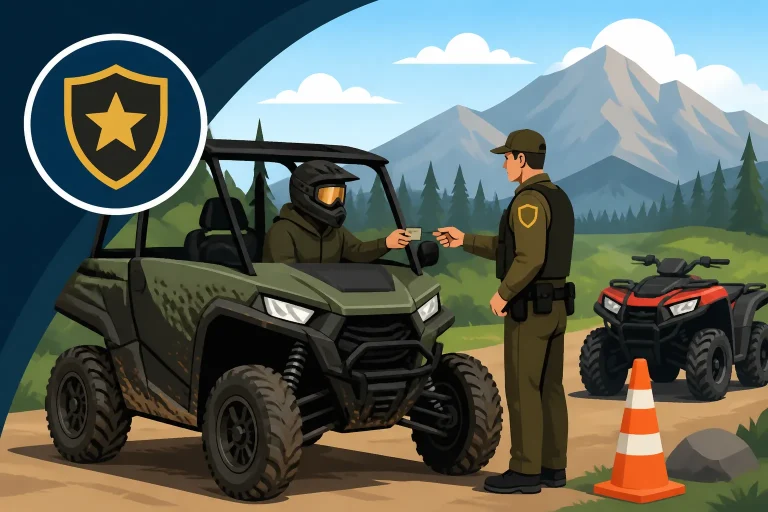
When in doubt, ask the authority responsible for the road and confirm the current requirements for a 12-year-old operator before the ride. Keep the route, supervision plan, and required documents clear enough that the adult can explain them if an officer or land manager asks. What a Montana Warden Asks a Rider For can help families understand what may come up during a check.
Disclaimer
This article is for general informational purposes only and does not constitute professional advice. Laws, prices and regulations vary by location and change over time. Consult a qualified professional for guidance on your specific situation.