Riding to Lunch Partway Through a Loop
A lunch stop can turn a Montana ATV or UTV loop into a relaxed day out, but only if the route actually connects to a place you can legally ride and park. A tempting café on the map may sit beyond a closed road or private land. This guide explains how to plan a practical mid-ride meal without losing track of access, fuel, time, or the return route.
Choose a lunch stop that fits the ride
Start with the route, not the restaurant
It’s easy to plan around a promising lunch spot and assume the rest will fall into place. In Montana, the safer approach is to map your riding route first, then look for a meal stop that fits the legal route you can actually take. A restaurant that appears close to a trail may be separated from it by a highway, private property, a closed road, or a stretch where OHVs aren’t allowed.
Look for a route that reaches a town or other established stopping place on roads open to your machine. Don’t treat a line on a recreational map as permission to ride there. Check the applicable motor vehicle use map and local road rules, and confirm that the final approach to the stop is allowed. Reading a Montana Motor Vehicle Use Map can help you understand why the route designation matters, while Montana Towns That Allow OHVs on Their Streets is a useful reminder that town access can vary from one community to another.
If your plan includes riding from trail to town, confirm the whole connection—not just the trail segment. A trail may end near a road without allowing you to continue along that road. Similarly, a town might permit OHV use on some streets but not others. Check the specific street or road you intend to use, including any restrictions on the route back out.
Pick a stop with a workable turnaround
The best lunch stop isn’t necessarily the one with the most appealing menu. It’s the one you can reach legally, park at without creating a problem, and leave without a stressful scramble to retrace your route. Look for a business with an appropriate place to park a trailer-free machine, or call ahead if the parking situation isn’t clear. A compact downtown lot, a busy fuel station, or a narrow roadside shoulder may not be a sensible place to leave a group of machines.
Think about the stop from the perspective of the people who live and work there. Keep machines out of pedestrian areas, driveways, loading zones, and spaces that block other vehicles. If the business doesn’t have a clear place for OHVs, ask before riding into the lot. A short phone call can prevent an awkward arrival—and help you avoid assuming that a restaurant welcomes a line of dusty machines simply because it’s near a riding route.
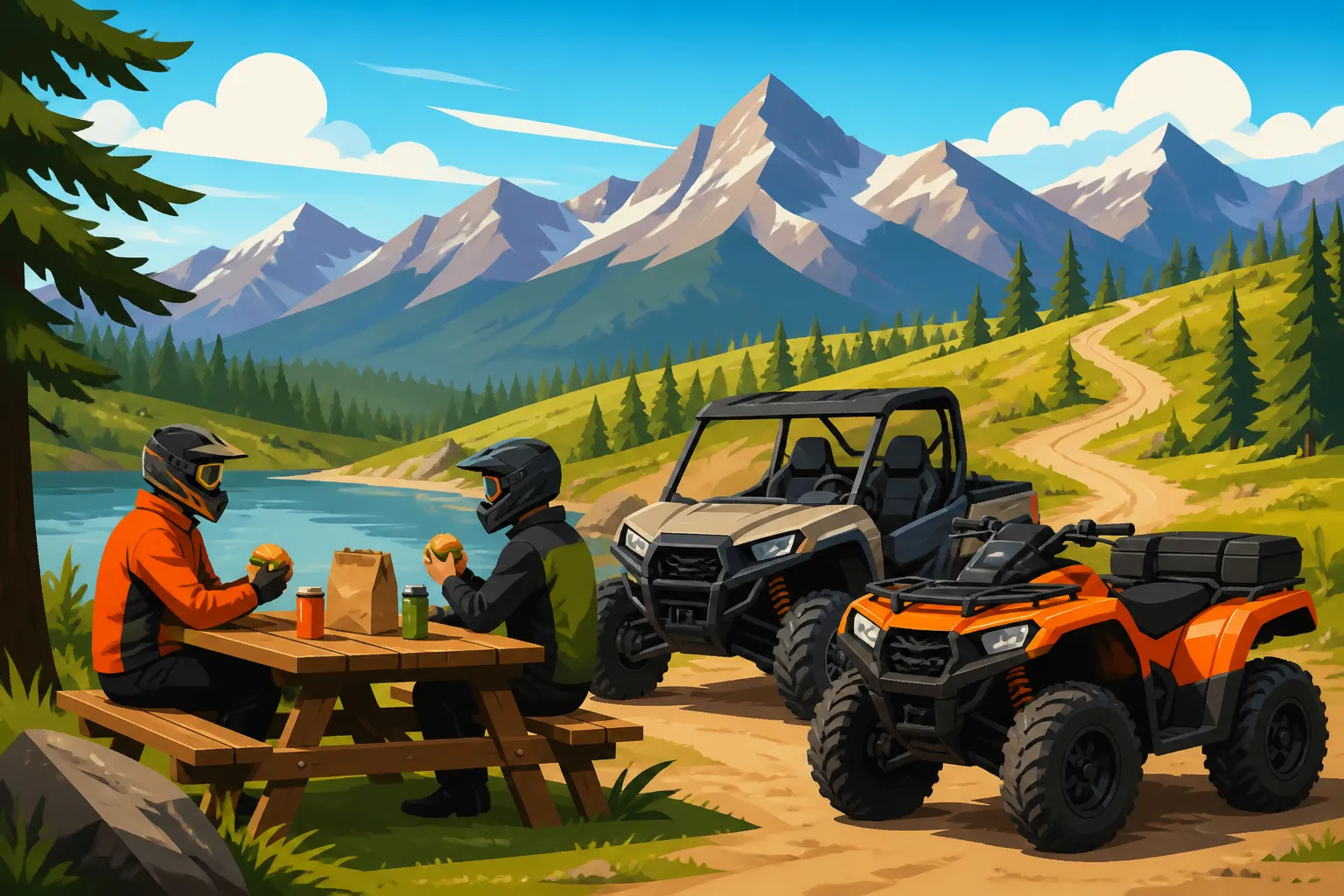
For some loops, a picnic lunch at a permitted staging or recreation area is more practical than riding into town. That can avoid road-access questions and make it easier to keep the day on schedule. Just check that stopping and eating are allowed at the location, pack out all food waste, and don’t leave food where it could attract wildlife.
Build a loop around time, distance, and fuel
Leave enough time for lunch and the ride back
A route that looks short on a screen can take longer than expected once you account for rough surfaces, elevation changes, trail traffic, dust, water crossings, and stops to regroup. Add a meal break, and a loop that seemed comfortably manageable can become a late-afternoon push. Estimate the riding time conservatively, and make sure your plan leaves enough daylight for the return.
Before setting out, divide the day into manageable parts: the ride to lunch, the length of the stop, and the ride back. Share a realistic return time with your group. If you’re travelling with children, newer riders, or people on machines with different capabilities, allow extra time for slower sections and regular breaks. The point of a lunch stop is to make the ride more enjoyable, not to turn the return leg into a race.
A map app can help you compare route options, and onX Offroad can be useful for reviewing a planned track and identifying nearby roads or recreation areas. Treat it as a planning aid, not as final proof that a road or trail is open to motorized use. Confirm the relevant route with official maps and local information before you ride. If you revise the plan at lunch, check the new route just as carefully as the original one.
Make fuel and range part of the lunch plan
Lunch is a natural point to check fuel, but it shouldn’t be the first time you think about range. Estimate fuel needs for the full day, including the return leg and a reasonable reserve for slower terrain or an unexpected detour. Don’t assume that a town stop has fuel available to your machine, or that a station will be open when you arrive. Fuel Planning for a Montana Trail Day is a helpful companion when you’re working out how much margin to build into the day.
If you expect to refuel in town, confirm that the station is accessible by a legal route and that it can accommodate your group. Some businesses have tight lots or limited space for machines, trailers, and support vehicles. Keep fuel containers secured and handle refueling away from food and pedestrian areas. If the stop is only for lunch, don’t plan as though a fuel pump will be available unless you have checked.
Use the stop to make a quick group check: fuel remaining, rider comfort, machine condition, and the time. A loose strap, a tire that looks low, or a rider who is already tired is easier to deal with before you leave town than several miles down a remote trail. If you notice a problem, adjust the plan rather than pressing ahead just to complete the loop.
| Lunch-stop option | Works well when | Check before riding |
|---|---|---|
| Restaurant in town | The town has a confirmed legal OHV route and suitable parking | Street rules, final approach, parking permission, and business hours |
| Fuel station with food | You need to refuel as well as eat | Legal access, fuel availability, machine parking, and space for the group |
| Picnic at a recreation area | You want to avoid riding into town | Whether the location permits access and stopping, plus waste and food-storage rules |
| Restaurant near a trailhead | The route connects directly to the business or its parking area | Private-property boundaries, road access, and whether machines may be left there |
Check access, local rules, and trail conditions
Verify every road connection
A lunch loop often combines different kinds of routes: public trails, forest roads, county roads, and streets within a town. Those segments may have different rules. Before leaving, check the status and permitted use of each section, not just the main trail. Route conditions and access can also change, so a familiar connection from a previous trip may not be open or appropriate this time.
For a route that leads into a town, review the local ordinance and identify the streets you’re allowed to use. Riding a Gravel Road Into Town offers relevant context for thinking through that kind of connection, but the road’s surface alone doesn’t tell you whether OHV use is allowed. A gravel road can still be closed to your machine, and a short stretch of pavement may have specific conditions.
Use onX Offroad to organize the route and keep track of your planned stops, but compare the plan with the responsible agency’s current map or notice. A map layer is not a substitute for posted signs, closures, or local restrictions. If the route is unclear, choose a more certain alternative instead of improvising at a junction or riding onto land you haven’t confirmed is open.
Plan for changing conditions and a safe return
Montana trail conditions can shift with weather, seasonal closures, fire activity, and maintenance. A route that is comfortable in dry conditions may become slow or difficult after rain or snowmelt. Check for closures before departure, and have a shorter backup option in case your original loop takes longer than expected. Checking Montana Trail Status Before You Drive can help you build that pre-trip check into your routine.
Don’t let lunch become the point where the group discovers it has no practical way back. Keep the return route saved, carry a paper map or another backup navigation option, and agree on what the group will do if riders get separated. Cell coverage can be limited away from town, so don’t depend on a phone connection to solve every navigation problem.
If the planned route becomes unsuitable, turn around or use a verified alternative. Avoid shortcuts across private land, closed trails, or road sections where OHVs aren’t permitted. If you’re running behind, a shorter return route that has been checked for legal access is better than trying to make up time by riding faster.
Make the stop comfortable for riders and the community
Keep the arrival and departure low-key
A group of machines can draw attention when it enters a small town, especially if it arrives dusty, loud, or all at once. Before you reach businesses or homes, slow down, leave room between machines, and follow local speed and road rules. Group Etiquette Riding Through a Montana Town has more to consider when your ride passes through a community.
Park only where you have permission, and leave space for customers, deliveries, and emergency access. Be ready to explain your planned route politely if a business owner or resident asks. If you can’t confirm that the parking area is appropriate, don’t assume you can leave machines there while the group eats.
Keep the stop tidy. Take your rubbish with you, avoid revving engines near homes or businesses, and don’t let the group spread across sidewalks or access points. A respectful visit makes it more likely that riders will continue to be welcome—and it’s simply the considerate way to use a community as part of a recreational outing.
Use lunch as a practical check-in
A meal break is a good time to check the group’s pace and make a realistic decision about the rest of the day. Ask whether everyone is comfortable, whether machines are running normally, and whether the current route still makes sense. If someone is tired or conditions have worsened, shorten the loop rather than treating the original plan as a promise that must be kept.
Before leaving, confirm that everyone knows the return route and agrees on a regrouping point. Check that bags, helmets, and other gear are secured, and make sure no one has left personal items behind. If the group has changed its route, review the new plan together rather than assuming each rider has followed the same update.
A good lunch stop should leave you rested, not rushed. Choose a destination you can reach legally, give the day enough time and fuel margin, and keep a verified route back in hand. That combination makes a mid-loop meal feel like part of the adventure instead of a complication.
Disclaimer
This article is for general informational purposes only and does not constitute professional advice. Laws, prices and regulations vary by location and change over time. Consult a qualified professional for guidance on your specific situation.