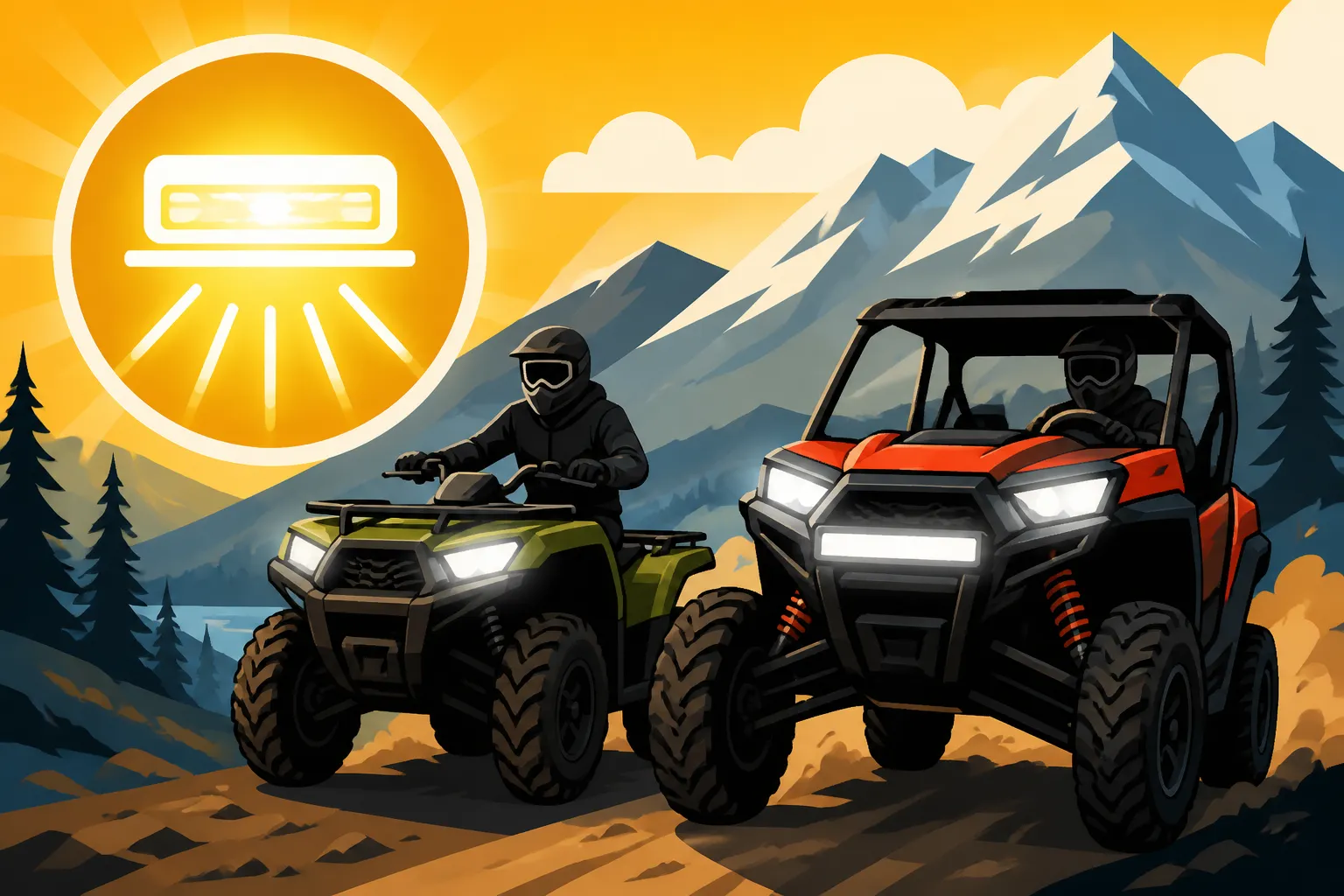
Lights That Must Stay On All Day
There’s a common misconception out there, especially among new ATV and UTV owners, that you only need to flip on your lights when the sun starts dipping below the mountains or when the weather gets a bit thick. But when you’re venturing onto Montana’s public roads, even a dusty gravel county road, thinking your lights are optional during daylight hours is a mistake that can cost you. This guide will clarify Montana’s specific requirements for ATV and UTV lighting, making sure you’re always visible and legal on the open road.
The Non-Negotiable Rule: Why Your Lights Must Stay On
It can feel a bit counterintuitive to have your headlights and taillights blazing on a bright, sunny Montana afternoon, especially when you're just cruising down a county road that feels more like a trail. But Montana law is quite clear: if your ATV or UTV is being operated on any public roadway, whether it's a paved highway shoulder, a town street, or a remote gravel two-track, your lights are required to be on, continuously. This isn't just a suggestion; it's a fundamental safety and legal requirement designed to protect you and everyone else sharing the road.
What Montana Statutes Say About Constant Illumination
Montana's statutes don't mince words when it comes to operating off-highway vehicles (OHVs) on public roadways. While many states have varying rules for daytime running lights, Montana simplifies it: your machine must be equipped with and operate at least one headlight and one taillight at all times when riding on designated public roads. This isn't limited to specific times of day, like from dusk till dawn, as it might be for some other vehicles. It means that the moment your tires hit a road that falls under public jurisdiction, those lights need to be shining. The idea is to make sure your smaller, often less conspicuous machine is as visible as possible to larger vehicles, pedestrians, and cyclists. It’s about being seen, not just seeing.
This rule applies universally across Montana, from the bustling streets of Missoula where [Riding an OHV on the Road in Montana] is allowed on certain routes, to the quiet backroads near a small ranching community. It removes any ambiguity, preventing riders from having to make judgment calls about lighting conditions or time of day. If you're on the road, your lights are on. It's that simple. This steadfast rule helps prevent misunderstandings and ensures a baseline of visibility for all OHV operators when they're off the trail and on the pavement or gravel.
Safety First: The Rationale Behind Constant Visibility
The primary reason behind requiring lights to be on all day is, quite simply, safety. ATVs and UTVs are inherently different from cars and trucks. They are typically smaller, narrower, and often less brightly colored, making them harder for other drivers to spot, especially at a distance or in challenging conditions. Imagine a scenario where a pickup truck crests a hill on a winding county road, and you’re on your UTV. Even on a clear day, the contrast of your machine against the background of trees, fields, or even the road itself can be poor.
Having your headlights and taillights illuminated acts as a beacon, significantly increasing your machine's conspicuity. It gives other drivers more time to see you, react, and adjust their driving, whether that means slowing down, moving over, or simply being more aware of your presence. This is especially crucial on roads where speeds are higher or visibility is limited by curves, hills, or even just the glare of the sun. It's not about how well you can see, but how well others can see you. This critical safety measure is designed to reduce the risk of collisions, which is always the top priority when sharing public thoroughfares with larger, faster vehicles.
Distinguishing Day vs. Night Requirements (and Why Day Matters So Much)
While the fundamental requirement in Montana is that your lights are always on when riding on public roads, regardless of the hour, there are still distinct differences in the quality and intensity of lighting systems needed for nighttime versus daytime operation. For example, while a basic headlight might suffice for daytime visibility, night riding demands a much more robust and well-adjusted lighting system to properly illuminate the path ahead and meet specific legal standards for brightness and throw distance. [Headlight and Taillight Rules in Montana] clearly outlines these differences.
During the day, the 'on' rule is primarily about being seen. Your lights act as an active signal of your presence. At night, it's a dual purpose: seeing the path and being seen. This means that while your basic factory lighting may satisfy the "on" requirement during daylight, you might want to consider upgrades if you plan on extended night rides. Aftermarket options from brands like SuperATV can offer significantly brighter and more focused light patterns, which are invaluable for navigating unlit roads safely after dark. However, for the purposes of the "lights on all day" rule, the key takeaway is that the light needs to be functioning and activated whenever you're on public access.
Essential Lighting Equipment for Montana Road Use
So, we’ve established that your lights need to be on. But what kind of lights are we actually talking about? It's more than just having a bulb glowing. Montana has specific requirements for the types and functionality of lighting equipment on your ATV or UTV if you intend to ride it on public roads. These requirements ensure that your machine is not only visible but also capable of communicating your intentions to other road users, which is a critical aspect of safe operation.
Headlights and Taillights: More Than Just Brightness
Every ATV and UTV intended for road use in Montana must be equipped with at least one headlight and one taillight. These aren't just for show; they need to be functional and meet certain standards. The headlight(s) must be capable of illuminating objects at a reasonable distance ahead, especially if you anticipate riding into the evening or at night. For daytime use, the primary function is to make your presence known. The taillight(s) are equally vital, ensuring that vehicles approaching from behind can clearly see you. This is where basic road-legal requirements often start.
Beyond the basic "on" requirement, consider the condition of your lights. Are they clear? Are the bulbs still bright, or are they dimming? Over time, plastic lenses can yellow and crack, reducing light output. If your factory lights aren't cutting it, or you simply want to enhance your visibility, there are many aftermarket options. Companies like SuperATV offer a variety of LED headlights and taillights that are often brighter, more durable, and consume less power than traditional incandescent bulbs, giving you a significant upgrade in both seeing and being seen. Remember, even if the law only requires a headlight and a taillight, having properly functioning and bright units can be a lifesaver, especially on busy county roads or when crossing intersections.
Brake Lights and Turn Signals: Communicating Your Intent
While headlights and taillights establish your presence, brake lights and turn signals communicate your intentions. These are non-negotiable for road-legal ATVs and UTVs in Montana. Your brake lights must illuminate when you apply the brakes, clearly indicating to drivers behind you that you are slowing down or stopping. This seems obvious for a car, but sometimes owners forget that their OHV needs the same level of functionality when on the road. Without working brake lights, you significantly increase the risk of a rear-end collision.
Turn signals are equally important. They allow you to signal turns and lane changes, preventing dangerous guesswork from other drivers. Many ATVs come from the factory without turn signals, as they aren't always required for off-road use. If you're adapting your machine for road legality, installing a reliable turn signal kit is a must. Again, aftermarket solutions, often complete with easy-to-install wiring harnesses and switches, are readily available. Brands like SuperATV specialize in these types of conversion kits, making it simpler for riders to get their machines compliant with [Turn Signals on a Montana Machine] and other road-specific requirements. Don't overlook these; clear communication on the road is just as important as being visible.
Reflectors and Other Visibility Enhancers
Beyond active lighting, passive reflectors also play a crucial role in your machine's visibility, particularly from the sides and rear, and especially if your electrical system were to fail. Montana law often requires certain reflector placements to ensure your OHV is visible from all angles. These typically include red reflectors on the rear and amber reflectors on the sides. While small, these reflective surfaces can catch the headlights of approaching vehicles, providing an extra layer of safety.
Many riders also opt for additional visibility enhancements, such as reflective tape on helmets or clothing, or even a brightly colored whip flag if allowed and appropriate for the road conditions. While these might not be explicitly mandated in the same way as headlights or brake lights, they contribute to the overall goal of ensuring you are as visible as possible when sharing the road. When you’re putting together your road-legal setup, think comprehensively about how to make your machine impossible to miss, particularly when you’re riding between a trail and town, as outlined in [Riding Town to Trailhead in Montana].
Understanding Enforcement and Staying Compliant
Knowing the rules is one thing, but understanding how they're enforced and what the consequences of non-compliance are is another. In Montana, law enforcement takes road safety seriously, and that includes ensuring OHVs operating on public thoroughfares meet all legal requirements. Ignoring these rules, even unknowingly, can lead to unwelcome interactions with local authorities, fines, and potentially more severe consequences if an incident occurs.
What a Montana Warden Asks For
When a Montana Fish, Wildlife & Parks (FWP) warden, county sheriff, or highway patrol officer pulls over an OHV on a public road, they're typically checking for a few key things beyond just your registration and permits. They'll be looking at the operational status of your lights. This includes verifying that your headlights and taillights are on, your brake lights illuminate when you squeeze the lever or press the pedal, and your turn signals (if equipped and required) flash correctly. They might also check for a functional horn and appropriate mirrors, as these are also critical components for road-legal OHVs.
They want to see that you've made a genuine effort to make your machine safe and compliant for road use. It's not just about having the equipment installed; it's about it being in good working order. A burned-out bulb or a non-functioning turn signal, even if you have the kit installed, still puts you out of compliance. They’ll also confirm you have your [Driver's License Rules for Montana Road Riding] in order and any required safety certificates, particularly for younger riders. Being prepared with all your documentation and a fully compliant machine can make a roadside stop quick and painless.
Penalties for Non-Compliance
Operating an OHV on a public road in Montana without the required lighting, or without having your lights on, can lead to a citation. The specific fines can vary, but generally, expect to pay a penalty that could easily sour your day's ride. Beyond the immediate financial hit, repeated offenses or involvement in an accident while non-compliant could lead to more serious legal repercussions, including increased liability. [Montana Fines for Illegal Road Riding] and [Montana Penalties for a Missing Decal] detail some of the common citations riders face.
It's also worth noting that if you're involved in a collision and your lighting was found to be non-compliant or not in operation, it could impact insurance claims or lead to findings of negligence. The state's intent with these rules is to enhance safety; disregarding them can have significant consequences. It’s always far better and cheaper to ensure your machine is properly equipped and your lights are on than to deal with the aftermath of a ticket or, worse, an accident.
Local Ordinances and Variations
While Montana state law sets the baseline, it's crucial to remember that local jurisdictions — counties, cities, and towns — often have their own specific ordinances regarding OHV use on their roads. While the "lights on all day" rule is generally consistent, there might be additional requirements or restrictions, such as specific hours of operation on certain streets, noise limits, or even additional safety equipment beyond state mandates. [Montana City Streets and Municipal Ordinances] explains this dynamic.
For example, a town might allow OHVs on most of its streets but prohibit them on the main thoroughfare, or require a certain type of insurance that goes beyond the state minimums. Before you plan a ride that takes you through a particular town or county, it's always a smart move to check with their local sheriff's office or city clerk's office. This ensures you're not caught off guard by a regulation unique to that area. It's rare for local rules to contradict the state's "lights always on" rule, but they might add to the list of things you need to be compliant with.
Beyond Lights: Other Key Road Riding Gear
While the focus of this guide is unequivocally on the "lights on all day" rule, it's crucial to understand that proper lighting is just one piece of the puzzle for safe and legal ATV/UTV road riding in Montana. To truly be compliant and ensure your safety and the safety of others, you need to consider a comprehensive approach to preparing your machine and yourself for public roads.
Helmets and Eye Protection: Protecting Yourself
Visibility for others is paramount, but your own protection is equally important. Montana has specific [Montana Helmet Rules for Riders Under 18] which mandate helmet use for anyone under that age, whether on a public road or not. For adult riders, helmets are strongly recommended, even if not strictly required by law in all situations on public roads. A good DOT-approved helmet can be the difference between a minor bump and a life-altering injury.
Beyond helmets, eye protection is another non-negotiable item. Dust, gravel, insects, and even sun glare can severely impair your vision, leading to dangerous situations. Goggles or a full-face helmet visor are essential for keeping your eyes safe and your vision clear. Remember, an accident due to impaired vision can happen in an instant, and prevention is always the best strategy.
Mufflers and Spark Arresters: Keeping it Quiet and Safe from Fire
When you transition from the trail to the road, noise levels become a much bigger concern, especially in residential areas or small towns. Montana law dictates that OHVs operating on public roads must be equipped with a functional muffler that keeps noise levels within acceptable limits. This isn't just about courtesy; excessive noise can also lead to citations. Aftermarket exhaust systems, while they might sound cool off-road, can sometimes exceed these limits, so it's something to be mindful of.
Equally important, particularly in a state prone to wildfires like Montana, is a spark arrester. While most modern ATVs and UTVs come with one from the factory, it's critical to ensure it's in good working order. A spark arrester prevents incandescent particles from escaping your exhaust and potentially igniting dry vegetation. While this is primarily a concern for off-road and wildland use, it’s a good habit to maintain for any OHV operation, especially if you're taking a shortcut through grassy areas to get to a specific road.
Driver’s License, Registration, and Insurance: The Paperwork
Even with the best lights and safety gear, you're not fully compliant without the correct documentation. Any person operating an OHV on a public roadway in Montana must possess a valid driver's license. This isn't like off-road riding where younger, unlicensed riders might operate under supervision; road riding demands licensed operators. [Driver's License Rules for Montana Road Riding] provides the full details here.
Your machine must also be properly registered and display current decals. Montana has a [Montana's One-Time Permanent OHV Registration] system, but you still need to ensure your paperwork is up to date. And finally, while Montana doesn't have a mandatory liability insurance requirement specifically for OHVs used only off-road, if you're riding on public roads, you absolutely need adequate liability coverage. Many auto insurance policies might not automatically extend to your OHV, so check with your provider to ensure you're covered for road use. Getting caught without these essentials is a quick way to derail your adventure.
| Requirement | Daytime Road Use | Nighttime Road Use | Notes |
|---|---|---|---|
| Headlights | REQUIRED | REQUIRED | Must be on and functional at all times on public roads. |
| Taillights | REQUIRED | REQUIRED | Must be on and functional at all times on public roads. |
| Brake Lights | REQUIRED | REQUIRED | Must illuminate when brakes are applied. |
| Turn Signals | REQUIRED | REQUIRED | Must be functional if installed/required for road use. |
| Reflectors (Red/Amber) | REQUIRED | REQUIRED | Typically required on rear (red) and sides (amber). |
| Horn | REQUIRED | REQUIRED | Must be audible from at least 200 feet. |
| Mirrors | REQUIRED | REQUIRED | At least one rearview mirror is typically required. |
| Muffler | REQUIRED | REQUIRED | Must meet state noise level regulations. |
| Spark Arrester | REQUIRED | REQUIRED | Required for public land use to prevent fires. |
| DOT-Approved Helmet | Recommended | Recommended | Required for riders under 18; highly recommended for all. |
| Eye Protection | REQUIRED | REQUIRED | Goggles or face shield for clear vision. |
| Driver's License | REQUIRED | REQUIRED | Valid driver's license for operator. |
| OHV Registration | REQUIRED | REQUIRED | Current Montana OHV registration and decals. |
| Liability Insurance | REQUIRED | REQUIRED | Check policy for road use coverage. |
Disclaimer
This article is for general informational purposes only and does not constitute professional advice. Laws, prices and regulations vary by location and change over time. Consult a qualified professional for guidance on your specific situation.