Water Crossings on Montana Trails
A shallow-looking creek can hide a deep hole, a soft bottom, or a current strong enough to push an ATV off balance. On Montana trails, snowmelt, storms, and changing stream levels can turn a familiar ford into a risky crossing. This guide explains how to assess water, cross only where permitted, prepare your machine, and know when turning around is the safest choice.
Before You Reach a Montana Trail Crossing
Confirm the crossing is legal and open
A visible track through water is not automatically an authorized route. The trail may cross private land, follow a seasonal restriction, or be closed to protect wildlife, water quality, or a damaged trail surface. Stay on the designated route and do not create a new crossing to get around a closure or obstacle.
Before leaving, check the route’s current status and the land manager’s map. A map app such as onX Offroad can help you follow a planned route and understand nearby terrain, but confirm important access details with official land-management information. In particular, check Reading a Montana Motor Vehicle Use Map and Checking Montana Trail Status Before You Drive. A line on a screen should not be treated as permission to ride.
Conditions can change between the trailhead and a crossing. A storm may raise a creek, muddy a low spot, or wash out an approach that looked fine on a map. A planned route near the Flathead, Bitterroot, or Gallatin ranges may pass through more than one drainage, and each crossing can behave differently. Do not assume that because one ford was manageable, the next one will be.
Account for snowmelt and recent weather
Montana’s high country can hold snow well into the riding season. As that snow melts, creeks may rise quickly, run colder and faster, and carry debris that makes the bottom harder to see. A familiar road or trail can feel very different during runoff than it did later in summer. Spring Runoff on Montana Back Roads and Fords Running High After Montana Snowmelt explain why timing matters.
Rain can cause a similar change, especially in narrow drainages where water collects quickly. If there has been heavy rain, a thunderstorm, or a warm spell after a snowy period, treat older reports and photos as background—not proof that a crossing is safe today. A useful habit is to check conditions before departure, then reassess at every crossing. Riding a Montana Trail After a Wet Week offers more context on how wet conditions affect routes.
Plan your turnaround before you set out. Tell someone where you expect to ride and when you plan to return, and avoid building a schedule that pressures you to cross just because you have already driven a long way. If the route becomes unsafe, the ride can end early. That is frustrating, but it is better than letting time, fuel, or a group’s enthusiasm make the decision for you.
How to Assess Water Before Crossing
Read the water, the banks, and the bottom
Stop well back from the water and look at the entire crossing. Pay attention to the current, the width of the channel, the entry and exit banks, and anything that could catch a tire or undercarriage. Fast-moving water can be hard to judge, particularly when the surface looks smooth. Foam, debris, ripples around rocks, and a visibly uneven surface may indicate movement or obstacles beneath it.
Look for signs of a damaged approach: fresh erosion, a steep or undercut bank, loose gravel, deep ruts, or water flowing across the trail rather than through a stable channel. A safe-looking entry does not help if the exit is too steep, muddy, or washed out. If the bottom is opaque and you cannot reasonably judge its shape or firmness, treat that uncertainty as a reason not to proceed.
Do not rely on another rider’s tracks as a depth gauge. The person ahead may have a different machine, tires, load, or ground clearance. Their crossing may also have disturbed the bottom, leaving a deeper rut or loosening the surface for the next vehicle. If you cannot confidently assess both the water and the exit, turn around or choose a permitted alternate route.
Decide whether to cross, wait, or turn back
There is no single depth number that makes every crossing safe. Water depth limits vary by machine and manufacturer, and current, hidden holes, entry angle, and water reaching vulnerable components all matter. Consult your owner’s manual for the machine’s stated limits, but remember that a published limit is not a promise that a particular crossing is safe.
Use this simple decision guide:
| What you observe | Safer response |
|---|---|
| The route is closed or the crossing is not clearly authorized | Do not cross; turn back or use a legal alternate route |
| The current is strong, the bottom is hidden, or the exit is damaged | Do not enter the water |
| Water is rising or recent weather has changed the flow | Wait for conditions to improve or end the ride |
| The crossing is authorized, shallow, slow-moving, and the entry and exit are stable | Proceed only if your machine’s limits and your riding ability allow it |
| You are uncertain, traveling alone, or unable to recover safely | Turn around |
If you decide to wait, do so from a safe location—not in the channel or on a fragile bank. Water levels may continue to rise, and waiting beside a crossing does not guarantee that it will become safe. When the right decision is to turn back, do not let the group split up or pressure a less experienced rider into attempting it.
Crossing Safely When Conditions Allow
Prepare the machine and the group
Before entering, secure loose cargo, confirm that riders are wearing appropriate protective gear, and agree on a simple plan. In a group, cross one machine at a time so there is room to react if someone stops or has trouble. Keep enough distance that a machine ahead cannot push you into the water, and make sure everyone knows where to regroup on the far side.
Know where your ATV or UTV’s air intake and other vulnerable components are located. Water entering the intake can cause severe engine damage, and a machine that stalls in water may be difficult to recover. A snorkel or aftermarket modification does not make a deep, fast, or unknown crossing safe. Follow the manufacturer’s guidance and never assume that added equipment removes the risk.
Think about recovery before anyone enters. If the machine gets stuck, can the group retrieve it without putting another rider in the current or damaging the bank? Carry suitable recovery equipment and know how to use it. Recovery Gear for a Montana Shelf Road discusses preparation for difficult terrain, while First Aid When Help Is Hours Out is a useful companion for remote rides where assistance may not be close.
Use a controlled approach and leave room to stop
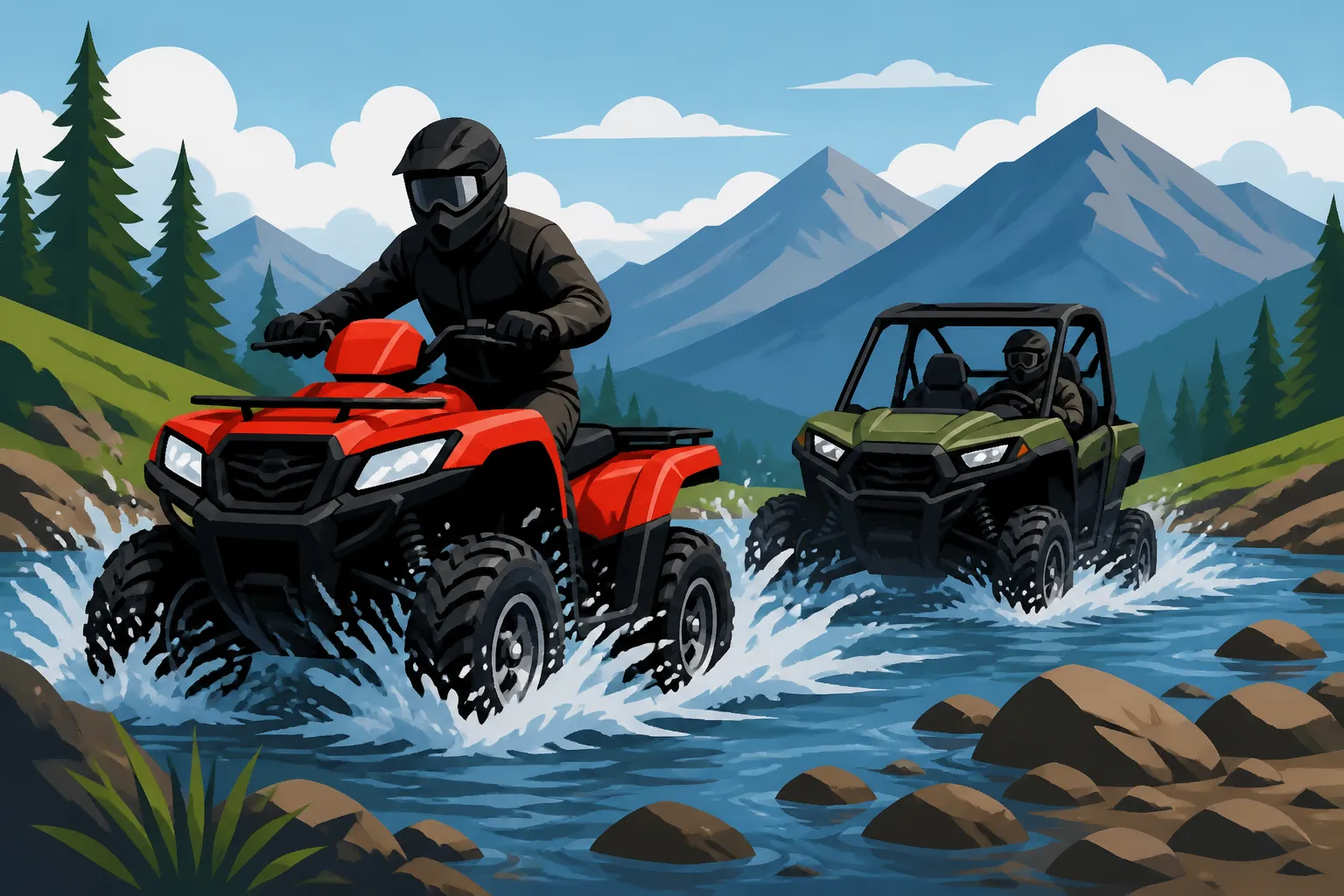
If the crossing is clearly legal and within your machine’s limits, approach slowly and steadily. Use a line that keeps the machine balanced and avoids obvious rocks, holes, and abrupt changes in depth. Avoid sudden acceleration, sharp turns, or stopping in the water unless an unexpected hazard makes stopping necessary. A UTV’s size and passenger load can affect how it responds, so account for the people and gear on board.
Do not ride alongside another machine in a narrow crossing. If one vehicle loses traction or stalls, extra space gives the next rider room to stop rather than becoming part of the same problem. On the far bank, move clear of the trail before checking the machine and waiting for the rest of the group. Keep the crossing itself open and avoid blocking other trail users.
Afterward, pay attention to warning signs such as an unusual engine sound, electrical problems, a wet air filter, or other symptoms listed in your owner’s manual. If you suspect water has entered the engine, do not keep trying to start it; repeated attempts can worsen damage. Follow the manufacturer’s instructions or get qualified help before continuing.
Protect the Trail and Know When to Stop
Avoid damage to water, banks, and trail surfaces
Use only the designated crossing and keep your tires on the established route. Riding upstream or downstream to search for an easier line can widen the disturbed area, damage vegetation, and create new ruts that channel water. Do not drive through a stream simply because its bed looks like an open path. An authorized route and a stable crossing matter as much as the machine’s ability to move through water.
When the approach is muddy, wheelspin can quickly deepen ruts and loosen the surface. If you are losing traction, stop rather than repeatedly spinning the tires or making several attempts from different angles. A crossing that might have been manageable can become a damaged, more hazardous obstacle for everyone behind you.
Follow posted signs, closures, and instructions from the land manager. If the trail is closed, do not cross around a barrier or use a streambed as a bypass. Montana Trail Closures in Fire Season is a reminder that access can change for reasons beyond weather, and Montana Rules on Forest Service Roads provides related information about riding on managed routes.
Make the turnaround part of the plan
The best crossing technique cannot make unsafe water safe. Turn back if the flow is forceful, the bottom is unknown, the far bank is unstable, the route is closed, or your group lacks a safe recovery plan. The same applies if a rider is tired, nervous, or inexperienced. A pause to reconsider is sensible riding, not a failure.
If a group disagrees, stop before the crossing and talk through the decision. Do not let the most confident person set the standard for everyone else. A cautious rider may be noticing a real problem, and a passenger may be less comfortable with a risk the driver is willing to accept. Choose the option that keeps the group together and out of danger.
Before your next ride, add water crossings to your route-planning checklist: confirm access, check recent weather and trail status, understand your machine’s limits, carry recovery and first-aid supplies, and agree that anyone can call for a turnaround. Those small decisions make it easier to enjoy Montana’s rivers and mountain scenery without treating a creek as an obstacle that must be conquered.
Disclaimer
This article is for general informational purposes only and does not constitute professional advice. Laws, prices and regulations vary by location and change over time. Consult a qualified professional for guidance on your specific situation.